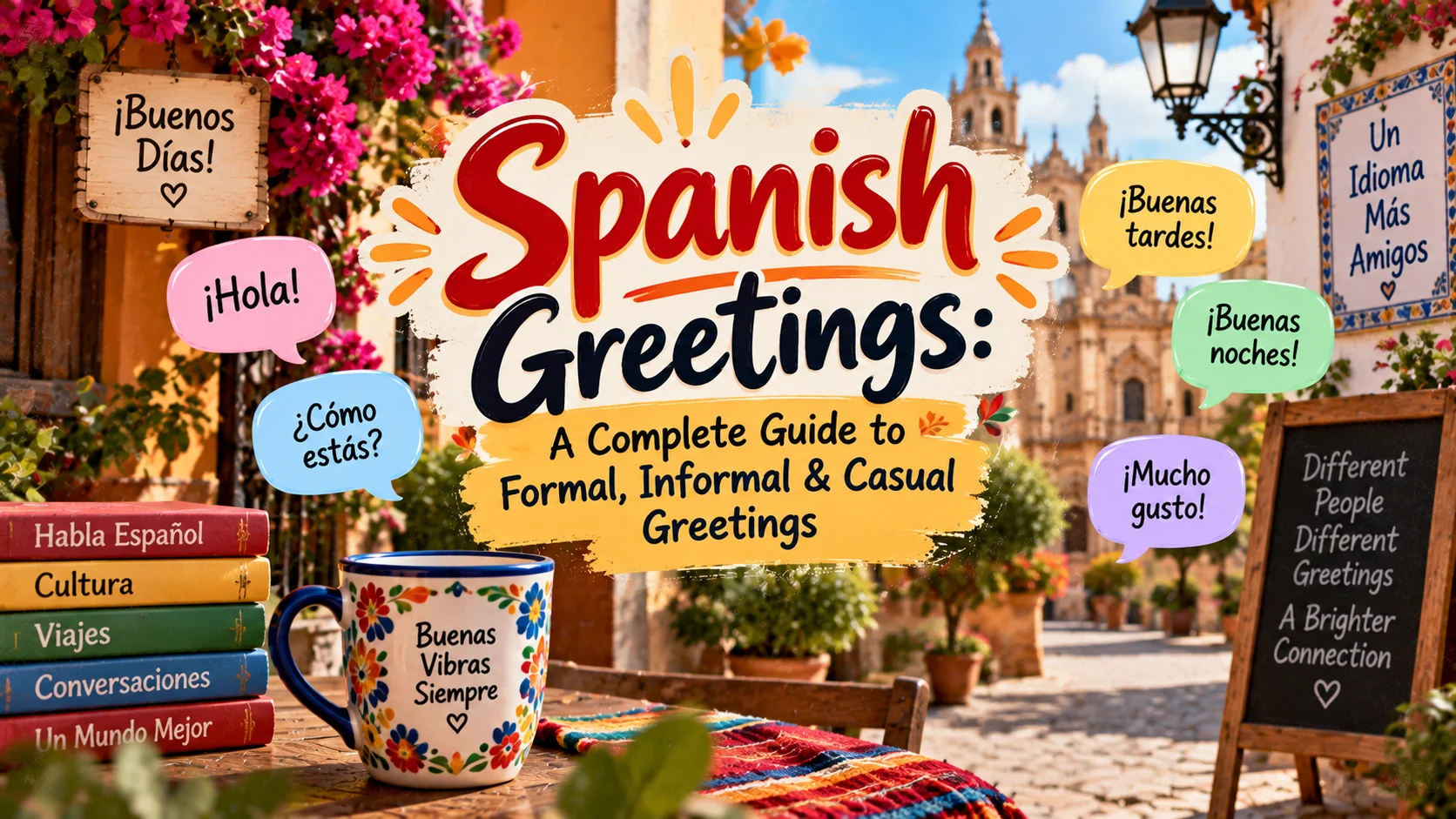
Spanish greetings are the first step to connecting with Spanish speakers. Knowing how to say hello in Spanish is probably the first and single most important skill to master as a Spanish learner . And spanish greetings, depending on the situation, go way beyond hola (hello) . From a casual greeting to a friend to a respectful “buenos días” for an elder, choosing the right phrase shows your understanding of the culture.
This comprehensive guide covers everything you need to know about spanish greetings. From formal business greetings to casual slang, from time-specific greetings to regional variations, you will find everything here. Whether you are learning Spanish for travel, work, or personal growth, this guide will help you greet anyone with confidence.
The Most Common Spanish Greetings
These are the most essential spanish greetings you need to know. They work in almost any situation.
- Hola is the most basic of the greetings, and it can be combined with any of the other ones found below. You can say, Hola, buenos días or Hola, buenas tardes. The h is silent . Hola can be used in both formal and informal situations no matter where you are in the Spanish-speaking world .
- Buenos días means “good morning” and is usually used until noon . Buenos días is a safe and polite choice for starting a conversation with a colleague, client, or stranger in the morning. It is one of the most common formal spanish greetings.
- Buenas tardes means “good afternoon” and is used if it is one o’clock or later in the day . In Spain, it may be used until later in the evening, while in most Latin American countries and the Caribbean, it may be used until the sun goes down .
- Buenas noches means “good evening” or “good night”. This phrase also means “goodnight.” Always be mindful of the context since you could be saying goodbye . Buenas noches is used after the sun goes down.
- Buen día is a shortened version of “good day” and is used in some regions as an alternative to buenos días .
Formal Spanish Greetings
Formal spanish greetings are used in professional settings, when meeting someone for the first time, or when speaking to someone older or in a position of authority. These greetings show respect and professionalism .
- ¿Cómo está? is a formal way of asking how someone is feeling. It is usually reserved for older people, authority figures, or as a sign of respect. In some South American countries, always use this one to be on the safe side . It is important that you inquire about a person’s well-being before beginning any type of business talk. It is an indication that you care about your client .
- ¿Cómo se llama? is the formal way to ask “What’s your name?” Use this with people you do not know well, older people, and authority figures .
- Señor is the formal way to address a man, equivalent to “Mr.” or “Sir” .
- Señora is the formal way to address a married woman, equivalent to “Mrs.” or “Ma’am” .
- Señorita is the formal way to address an unmarried woman, equivalent to “Miss” .
- Encantado de conocerle is a formal way to say “Nice to meet you.” This is used mainly in Spain . Encantado is used by male speakers and encantada by female speakers .
- Mucho gusto means “pleased to meet you.” This is a neutral greeting that works in both formal and informal settings .
Bienvenido is the formal way to say “welcome.” If you are speaking to a female, say bienvenida; for a gentleman, say bienvenido. Welcoming a group? Use bienvenidos for a mixed group or group of males, and bienvenidas for a group of females .
Informal Spanish Greetings
Informal spanish greetings are used with friends, family, and people you know well in casual situations. They are warm, friendly, and show familiarity .
- ¿Cómo estás? is the informal way to ask “How are you?” The S at the end indicates that you are talking to someone your same age or younger. If you hear tutéame, you have permission to address the person in the informal way, regardless of age .
- ¿Cómo te llamas? is the informal way to ask “What’s your name?” This literally means “What do you call yourself?” and this is what you ask to find out someone’s name .
- ¿Qué tal? means “How’s it going?” For some it may be informal, but in general this question can be used with anyone in a non-business setting . In fact, this is arguably the most natural way to greet people in Spanish .
- ¿Qué pasa? means “What’s happening?” or “What’s up?” Talking to your friends or someone younger than you? Use the phrase ¿Qué pasa? You may also hear this one when someone wants to know if something is wrong .
- ¿Qué hubo? means “How’s it going?” This is considered informal in some countries. Use it with your friends and family. Just remember the rule about the silent H . It is used mostly in Mexico, Colombia, and Argentina .
- Hola is the standard informal greeting for friends and family. It can be used in both formal and informal situations no matter where you are in the Spanish-speaking world .
- ¡Hola! ¿Cómo estás? is the most common way to greet someone you know well.
Very Informal Spanish Greetings
Very informal spanish greetings are used with close friends and family. Some, depending on how well you get along with the person, could result in awkward tension if you have miscalculated your social standing with them .
- ¿Qué onda? means “What’s up?” This is popular in Mexico and Central America .
- ¿Qué cuentas? means “What’s up?” in a casual way .
- ¿Cómo andas? means “How are you doing?” This is an informal way to ask how someone is .
- ¡Qué gusto verte! means “What a pleasure to see you!” .
- ¡Qué bueno verte! means “So good to see you!” .
- ¡Qué milagro! means “Long time, no see!” or “It’s been a while!” .
- ¿Qué pasa, huevón? means “What’s up, dude?” This fun greeting is pretty much just used in South America .
- ¿Qué onda, microonda? means “What wave, microwave?” This is a funny way to greet people in Chile, where the more standard ¿Qué onda? rules the day .
Time-Specific Spanish Greetings
- Time-specific spanish greetings are based on the time of day. They are polite and show awareness of the time .
- Buenos días is used from sunrise until noon. It is the most common morning greeting among spanish greetings.
- Buenas tardes is used from noon until early evening. It is the standard afternoon greeting among spanish greetings.
- Buenas noches is used from early evening until bedtime. It is the standard evening greeting among spanish greetings.
- Muy buenas is a shortened version of any of the above. It can be used any time as an informal “hello” like shortening to “Morning” or “Afternoon” .
Greetings for Introductions
When meeting someone for the first time, these spanish greetings help you make a good impression.
- Mucho gusto means “Nice to meet you.” This is an easy thing to say to anyone you are meeting for the first time. It literally means “much pleasure,” but you can use it to express your happiness in meeting someone .
- Encantado / Encantada means “Pleased to meet you.” This is used mainly in Spain. The gendered ending of encantado refers to the speaker while the gendered ending of conocerlo refers to the recipient .
- Igualmente means “Likewise.” When someone says “Nice to meet you” using one of the expressions above, you can reply with igualmente, which literally means “equally” .
- Me llamo [Name] means “My name is [Name].” When someone asks your name, reply with Me llamo followed by your first name .
- ¿Cómo te llamas? is the informal way to ask “What’s your name?” .
- ¿Cómo se llama? is the formal way to ask “What’s your name?” .
Phone Spanish Greetings
Answering the phone in Spanish can be intimidating, but these spanish greetings will help you start the conversation right .
- ¿Aló? is a common way of answering the phone in many Spanish-speaking countries. Depending on where you travel, you may hear bueno, sí, and diga used for answering a phone call .
- ¡Bueno! is common in Mexico when answering the phone .
- ¿Diga? or ¡Dígame! means “Tell me?” and is common in Spain .
- ¡Sí! is also used when answering the phone in some regions .
- Regardless of the greeting, respond by saying who you are and make sure to inquire how they are. It is impolite not to ask .
Email Spanish Greetings
Written spanish greetings for emails and letters require a slightly different format.
Formal Email Greetings
Estimado señor / Estimada señora means “Dear Sir / Dear Madam.” This is used for formal emails when you know the recipient’s gender but not their name .
A quien corresponda means “To whom it may concern.” This is useful for starting an email when you do not know the name of the person you are addressing, like when writing to a company .
Muy señor mío / Muy señora mía means “Very much my sir / my madam.” This is a very formal greeting for letters .
Informal Email Greetings
- ¡Hola! Espero que este mensaje te encuentre bien. means “Hello! I hope this message finds you well.” This is a friendly way to start an informal email .
- Querido / Querida means “Dear.” This is used for informal emails to friends and family .
- ¡Buen día! means “Good day!” and is a friendly way to start an email .
Email Greeting Rules
Use a colon (:) rather than a comma after an introductory greeting when writing a letter in Spanish .
How to Respond to Spanish Greetings
Knowing how to respond to a greeting is just as important as knowing how to give one.
- When someone says Buenos días, respond with Buenos días.
- When someone says Hola, respond with Hola.
- When someone asks ¿Cómo estás?, you can respond with:
- Bien, gracias. ¿Y tú? (Fine, thank you. And you?)
- Muy bien, gracias. (Very well, thank you.)
- Más o menos. (So-so.)
- Regular. (Okay / Not great.)
- Estoy bien. (I am good.)
- When someone says Mucho gusto, respond with Igualmente (Likewise) or El gusto es mío (The pleasure is mine).
- When someone says Encantado, respond with Igualmente.
- When someone says Buenas tardes, respond with Buenas tardes.
- When someone says Buenas noches, respond with Buenas noches.
Non-Verbal Spanish Greetings
Spanish greetings often involve more than just words . The way you greet someone physically is just as important as what you say .
Cheek Kissing (El beso)
In Latin America, you usually do one kiss on one cheek . In Spain, you do two kisses—one on each cheek . These kisses are just personal greetings; the kisses are not romantic in any sense. You usually do not even actually kiss. Your cheeks just rub together and you kiss the air .
Generally speaking, men do not kiss each other’s cheeks to say hello or goodbye, except in some circles and in Spain . However, men are likely to kiss when giving congratulations to close friends or relatives . In some Latin American countries, kisses are even sometimes used as greetings in business situations between men and women or between two women .
Handshakes and Hugs
Handshakes are used in business situations and also among male friends, whether you are in Spain or Latin America . If you are feeling extra enthusiastic, you can show it by going for a one-armed hug and giving the person a few pats on the back .
Among men it is more usual to greet friends with a hug or a pat on the back, although some male relatives and friends kiss as well . In formal or business situations the norm is to shake hands .
Following Their Lead
The best way of judging what to do and thereby avoiding appearing too formal is to follow the lead of others or wait to see whether the person you are meeting offers an outstretched hand or leans towards you .
Regional Differences in Spanish Greetings
Spanish is rich with regional differences . While spanish greetings are understood everywhere, you might hear local favorites.
- In Spain, ¿Cómo estáis? is used for a group, while Latin America uses ¿Cómo están? .
- In Mexico and Central America, ¿Qué onda? is a very common casual greeting .
- In Colombia and Central America, quiubo (short for ¿qué hubo?) is popular .
- In Chile, ¿Qué onda, microonda? is a funny way to greet people .
- In South America, ¿Qué pasa, huevón? is a fun way to greet friends .
- In Argentina and Uruguay, you might hear ¡Che! as a casual greeting.
Common Mistakes to Avoid with Spanish Greetings
Using the wrong formality level is a common mistake. Do not use informal greetings with strangers, elders, or authority figures. Use formal greetings to show respect .
Using Buenas noches as a greeting when arriving somewhere is correct, but remember it can also mean goodnight as a farewell. Be mindful of the context .
Forgetting to ask how someone is doing after greeting them can be seen as impolite. It is an indication that you care about the person .
Mispronouncing words like Hola (silent H) or ¿Qué hubo? (silent H) can cause confusion. Remember the rule about the silent H in Spanish .
Using the wrong gendered form for adjectives like bienvenido, encantado, or the endings of greetings can make you sound less fluent. Pay attention to whether you are speaking to a male, female, or group .
Frequently Asked Questions About Spanish Greetings
What Is the Most Common Spanish Greeting?
Hola is the most basic and common greeting in Spanish. It can be used in both formal and informal situations no matter where you are in the Spanish-speaking world. Buenos días, buenas tardes, and buenas noches are also very common for time-specific situations.
What Is the Difference Between ¿Cómo Está? and ¿Cómo Estás?
¿Cómo está? is formal and used with older people, authority figures, or as a sign of respect. ¿Cómo estás? is informal and used with friends, family, and people your same age or younger.
How Do You Respond to Mucho Gusto?
Respond with Igualmente (Likewise) or El gusto es mío (The pleasure is mine).
Do You Kiss on the Cheek in Spain?
Yes, in Spain, you do two kisses—one on each cheek. In Latin America, you usually do one kiss on one cheek. These are personal greetings and are not romantic in any sense.
What Is the Best Greeting for a Job Interview in Spanish?
Use formal greetings in a job interview. Say Buenos días or Buenas tardes. Use ¿Cómo está? and Mucho gusto. Shake hands firmly. Use Señor or Señora with the person’s last name.
How Do You Greet Someone in an Email in Spanish?
For formal emails, use Estimado señor or Estimada señora. For informal emails, use Hola or Querido/Querida. Use a colon (:) rather than a comma after the greeting.
How Do You Answer the Phone in Spanish?
Common phone greetings include ¿Aló?, Bueno, ¿Diga?, and ¡Sí!, depending on the country. Always respond by saying who you are and inquire how they are. It is impolite not to ask.
What Does ¿Qué Tal? Mean?
¿Qué tal? means “How’s it going?” For some, it may be informal, but in general, this question can be used with anyone in a non-business setting. In fact, it is arguably the most natural way to greet people in Spanish.
Conclusion
Spanish greetings are the foundation of every conversation in Spanish. From formal Buenos días to casual Hola, from time-specific Buenas tardes to regional ¿Qué onda?, knowing the right greeting for the right situation is essential. This guide has covered everything you need to know about spanish greetings. You now have the tools to greet anyone with confidence, whether in a formal business meeting, a casual social gathering, or a professional email.
Remember to consider the time of day, the person’s age, your relationship, and the setting when choosing a greeting. Practice using different spanish greetings in different situations. Soon, choosing the right greeting will feel natural and effortless.
So go ahead. Greet someone in Spanish today. A simple Hola can start a beautiful conversation. A warm Buenos días can brighten someone’s day. Your words have power. Use them well. ¡Buena suerte! (Good luck!)