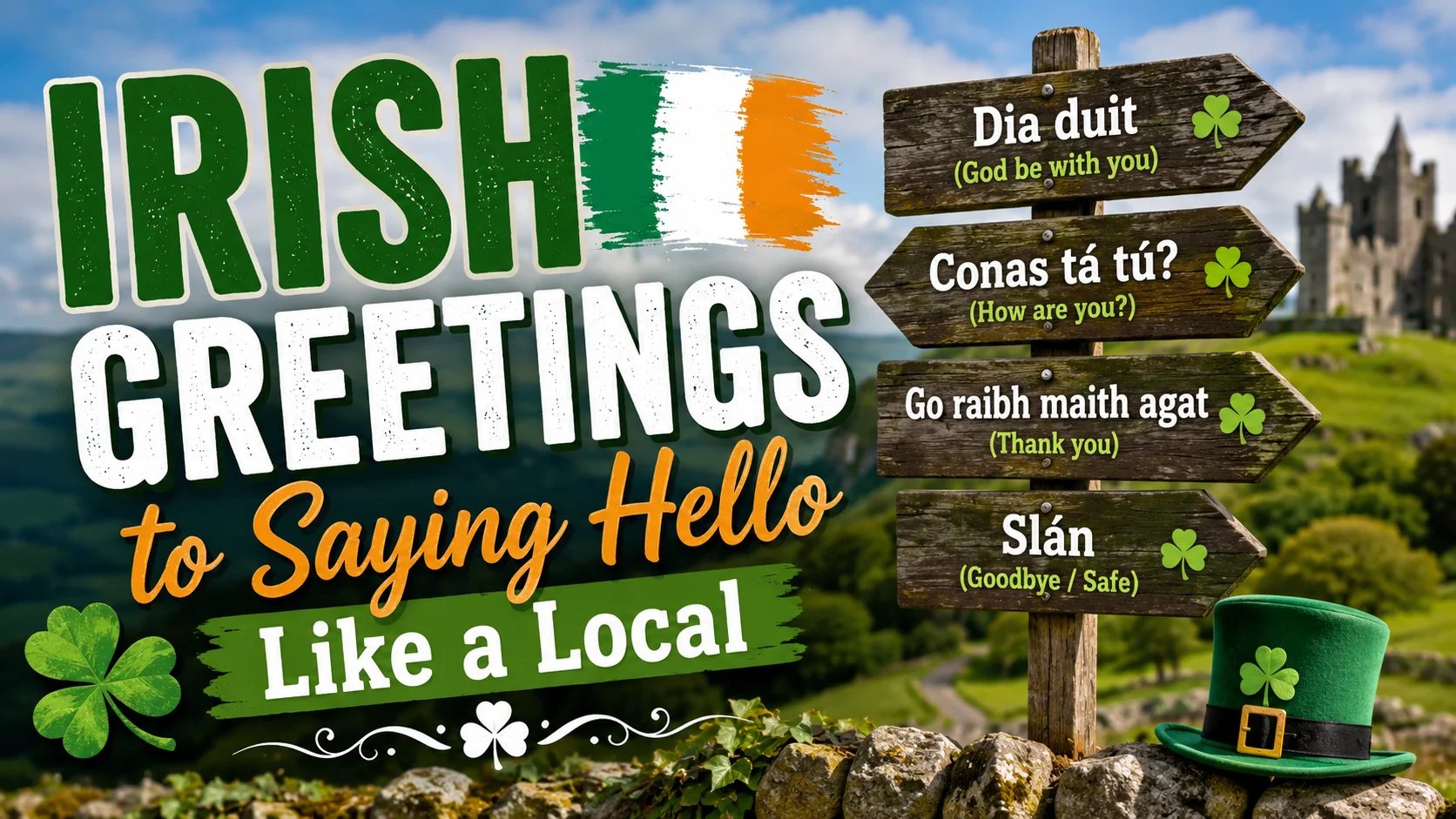
Irish greetings are known worldwide for their warmth, wit, and unique charm. Whether you’re planning a trip to the Emerald Isle, connecting with Irish friends, or simply want to add some Celtic flair to your conversations, learning how the Irish say hello is both fascinating and fun. From the ancient Irish language greeting “Dia duit” (meaning “God be with you”) to the famous “What’s the craic?” – Irish greetings reflect the country’s rich history, deep faith, and legendary sense of humor. This comprehensive guide explores the many ways to greet someone in Ireland, covering everything from formal handshakes to slang phrases, Irish blessings, and cultural etiquette. So whether you’re a visitor or just Irish at heart, may the road rise up to meet you on this linguistic journey through the best Irish greetings and blessings! 🍀
If you enjoy learning greetings from around the world, don’t miss our guides on Spanish greetings and German greetings, where you’ll discover more ways to greet people in different cultures.
Dia Duit: The Traditional Gaelic Greeting 🇮🇪
- The traditional Irish-language greeting is “Dia duit” (pronounced “dee-a gwit”), which literally means “May God be with you.”
- If someone says “Dia duit” to you, the correct response is “Dia is Muire duit” (pronounced “dee-a iss mwir-a gwit”), meaning “God and Mary be with you.”
- This formal greeting is still used today in Ireland’s Gaeltacht (Irish-speaking) regions and adds a touch of tradition to any conversation.
- For a more casual hello, you can simply say “Haigh” (pronounced “hi”).
- To ask someone how they are in Irish, you would say “Conas tá tú?” (pronounced “kun-ass taw too”).
- A common response is “Go maith, buíochas le Dia” (pronounced “guh-mah, bweek-us leh dee-ah”), meaning “Good, thanks be to God.”
- When saying goodbye, the Irish use “Slán” (pronounced “slawn”), which also means “safe” in Irish.
- To say thank you, say “Go raibh maith agat” (pronounced “gur-rah mah ag-ut”).
- And a simple “Sláinte” (pronounced “slawn-cha”) is the traditional Irish cheers, meaning “health.”
- Learning these few words is a wonderful way to show respect for the Irish language and culture.
- The Irish language, also known as Gaelic, is one of the oldest living languages in Europe.
- Many Irish people take great pride in their native language and appreciate when visitors make an effort to learn a few words.
What’s the Craic? Understanding Irish Slang 😂
- If there’s one greeting you need to know, it’s “What’s the craic?” (pronounced “crack”).
- In Ireland, “craic” means news, gossip, fun, or entertainment, so asking this is the Irish way of saying “What’s happening?” or “How are things?”
- A typical response to “What’s the craic?” is “Ah, sure you know yourself,” or “Not a whole lot.”
- If you had a good time, you might say “It was mighty craic!”
- The word “craic” is actually an old English word that evolved in Ireland to mean fun and news.
- You might also hear “How’s she cuttin’?” which refers to the state of the turf but is used as a general greeting.
- In Ulster, particularly Donegal, men often greet each other with “Ye boy” or “Hup ye boy ye.”
- A very common greeting is simply “How ya?” which is short and friendly.
- In Belfast, you might hear “‘Bout ye?” which is a shortened form of “How’s about ye?”
- In the midlands, a long, drawn-out “We-he-ell?” is often used as a greeting.
- The Irish love their slang and using it correctly can make you feel like a local in no time.
- Irish slang is constantly evolving, with new words and phrases being added all the time.
Top of the Morning: Fact vs. Fiction 🎩
If you’re looking for more everyday morning expressions, check out our complete collection of morning greetings for every occasion.
- Contrary to popular belief, the phrase “Top of the morning to you” is rarely used in modern Ireland.
- While the phrase does have Irish origins and appears in 19th-century literature like Charles Kickham’s 1879 novel “Knocknagow,” it’s now considered outdated and clichéd.
- The phrase likely became associated with Irish greetings through American movies like “The Quiet Man” and tourism advertisements.
- If you use it in Ireland today, you will likely get a polite smile, but locals will know you’re a visitor.
- A more authentic Irish greeting is simply “Hello,” “How are you?” or “What’s the story?”
- On the other hand, the traditional farewell “May the road rise up to meet you” is still very much used and cherished by the Irish.
- So, when in Ireland, forget “Top of the morning” and try “What’s the craic?” instead.
- Many Irish people find the phrase amusing because it sounds like something from an old movie.
- The Irish prefer more down-to-earth and genuine greetings rather than overly formal or theatrical ones.
- Using authentic Irish greetings will earn you more respect and warmer responses from locals.
Traditional Irish Blessings for Every Occasion ✨
- “May the road rise up to meet you. May the wind be always at your back. May the sun shine warm upon your face, and rains fall soft upon your fields. And until we meet again, may God hold you in the palm of His hand.” This is the most famous Irish blessing, used for farewells and good wishes.
- “May you be poor in misfortune, rich in blessings, slow to make enemies, quick to make friends.” This beautiful blessing is perfect for wishing someone a happy and prosperous life.
- “May the most you wish for be the least you get.” A simple yet powerful blessing meaning you want more for your friend than they even dream of for themselves.
- “May love and laughter light your days and warm your hearth and home.” A perfect blessing for a housewarming or to celebrate family and friends.
- “May peace and plenty be the first to lift the latch to your door.” A blessing wishing someone a life filled with peace and abundance.
- “May the hinges of our friendship never grow rusty.” A wonderful blessing for a close friend.
- “May you have warm words on a cold evening, a full moon on a dark night, and a smooth road all the way to your door.” This is a comforting blessing to send to someone far away.
- “May the lilt of Irish laughter lighten every load.” A wish for joy to make life’s burdens feel lighter.
- “If you’re lucky enough to be Irish… you’re lucky enough!” A playful and proud saying celebrating Irish heritage.
- These blessings are often shared at weddings, funerals, and other significant life events.
- Many Irish families pass these blessings down through generations as a cherished tradition.
The History and Meaning of Irish Blessings 📜
- Irish blessings have a long and storied history, with roots stretching back to ancient Celtic times.
- The Celts were a pagan people who worshipped nature and had a rich tradition of oral storytelling and poetry.
- As Christianity spread throughout Ireland, many old pagan traditions were incorporated into the new religion.
- The Celtic love of poetry and storytelling was embraced by Christian monks, who began to write down and preserve these ancient blessings.
- Many Irish blessings feature beautiful imagery and symbolism drawn from the natural world, such as the sun, the sea, and the stars.
- Some Irish blessings also reference important religious figures, such as St. Patrick, the patron saint of Ireland.
- Today, Irish blessings are cherished all around the world and are often used to celebrate special occasions and bring comfort in times of need.
- The Lorica of Saint Patrick, also known as the Breastplate of Saint Patrick, is one of the most famous ancient Irish prayers.
- Another well-known example is the ancient prayer, “I arise today through the strength of heaven…”
- These blessings, filled with words of hope and faith in God’s promises, make the world feel a little brighter.
- The poetic nature of Irish blessings reflects the deep connection the Irish have with nature and spirituality.
Funny Irish Sayings and Proverbs 😂
- “May your troubles be as few and as far apart as my grandmother’s teeth.” A classic humorous blessing about having very few troubles.
- “May you be in heaven a full half hour before the devil knows you’re dead.” A famous funny blessing, hoping you make it to paradise before the devil can catch you.
- “May the cat eat you, and may the devil eat the cat.” An Irish curse that is a creative way of telling someone to go to hell.
- “As you slide down the banisters of life, may the splinters never point the wrong way.” A funny wish for a smooth journey through life.
- “He didn’t lick it off a stone.” This saying means that someone learned a bad habit or trait from those around them.
- “You’ll never plow a field by turning it over in your mind.” Meaning that merely thinking about something won’t get it done; you have to take action.
- “A good laugh and a long sleep are the two best cures.” A classic Irish proverb emphasizing the importance of rest and joy.
- “Stop acting the maggot.” A phrase you’d say to someone who’s fooling around or acting silly when they shouldn’t be.
- “I wouldn’t call the Queen my aunt.” A phrase meaning you’re in such a good mood that even becoming royalty couldn’t improve it.
- “It’s better to pay the butcher than the doctor.” A wise Irish saying to eat well so you stay healthy.
- Irish humor is famous worldwide for its wit, warmth, and ability to find laughter even in difficult situations.
- Many Irish sayings use exaggeration and irony to make a point, which is a hallmark of Irish comedy.
How to Greet Someone in Ireland: Social Etiquette 🤝
- The most common greeting in Ireland is a handshake.
- The Irish usually shake hands when being introduced or when greeting a friend or work colleague.
- In formal situations or with people of higher status, titles and last names are used.
- Among close friends and family, the Irish may hug and kiss each other on the cheek.
- Women will kiss both male and female friends, while men kiss only female friends.
- When addressing friends, family, and acquaintances, the Irish will generally use first names.
- In more rural areas, people will greet each other when passing on the street.
- People in urban areas reserve such greetings for neighbors and people they know.
- The Irish usually hold eye contact when greeting someone.
- When being introduced to family, it is customary to shake hands with older children as you would with adults.
- The Irish value politeness and good manners, so always greet people with a smile.
- Being friendly and approachable is highly valued in Irish culture.
Sláinte: How to Say Cheers in Irish 🍻
- “Sláinte!” (pronounced “slawn-cha”) is the most common way to say cheers and means “health.”
- “Sláinte mhaith” (pronounced “slawn-cha wah”) means “good health” and is a more emphatic toast.
- “Sláinte is táinte!” (pronounced “slawn-cha iss tawn-cha”) means “health and wealth.”
- A longer traditional toast is “Sláinte na bhfear agus go maire na mná go deo!” which means “Cheers to the men and may the women live forever!”
- The word “sláinte” is one of the most famous Irish words and is known worldwide.
- It is a perfect way to toast a friend, a celebration, or just a good time.
- When making a toast in Ireland, it’s customary to look the other person in the eye.
- Many Irish people will clink glasses and say “Sláinte” before taking a drink.
- The Irish are known for their love of socializing, and toasting is an important part of their culture.
- Whether you’re in a pub or at a family gathering, “Sláinte” is always the right thing to say.
Useful Irish Words and Phrases for Travelers 🗣️
- Yes – “Tá” (informal) or “Sea” (more common).
- No – “Níl” (informal) or “Ní hea” (more common).
- Please – “Le do thoil.”
- Thank you – “Go raibh maith agat.”
- Goodbye – “Slán.”
- Goodnight – “Oíche mhaith.”
- Excuse me – “Gabh mo leithscéal.”
- I’m sorry – “Tá brón orm.”
- I don’t understand – “Ní thuigim.”
- Do you speak Irish? – “An bhfuil Gaeilge agat?”
- Welcome – “Fáilte.”
- This is a basic vocabulary that will be appreciated wherever you go in Ireland.
- Even if you only learn a few words, the Irish will appreciate the effort.
- Many Irish people are happy to help you with pronunciation if you ask.
Inspirational Irish Sayings and Proverbs 🧠
- “Two people shorten the road.” Meaning that every journey goes faster with company.
- “A good word never broke a tooth.” This means you don’t lose anything by being kind.
- “You’ve got to do your own growing, no matter how tall your father was.” This proverb means you have to make your own way in life.
- “It’s often that a man’s mouth broke his nose.” A warning to watch what you say because it could get you in trouble.
- “Even black hens lay white eggs.” Meaning you should never judge a book by its cover.
- “A full cabin is better than an empty castle.” This Irish proverb means that having a loving home is better than living alone in a big house.
- “The older the fiddler, the sweeter the tune.” Meaning we get better with age and experience.
- “There’s no use boiling your cabbage twice.” Meaning there’s no point in going over and over worries in your head because it solves nothing.
- “A broken man is better than no man.” This can be interpreted as it being better to have an imperfect partner than to be alone.
- Irish proverbs often contain deep wisdom and practical advice for everyday life.
- These sayings have been passed down through generations and are still used today.
Regional Irish Greetings from Different Counties 🗺️
- In Dublin: You’ll hear “How’s she cuttin’?” and “What’s the story?”
- In Cork: Locals might greet you with “How’s the form?” or “Well, boy!”
- In Galway: A friendly “How’s the craic?” is common, along with “Are you well?”
- In Kerry: You might hear “What’s the news?” or “How’s the going?”
- In Belfast: “‘Bout ye?” is a classic greeting, along with “What’s the craic?”
- In Donegal: “Ye boy” or “Hup ye boy ye” is common among men.
- In Limerick: A simple “How’s it going?” is widely used.
- In Waterford: “Well, wha?” is a local favorite.
- In Mayo: “How’s the road?” is a traditional greeting.
- In the Midlands: A drawn-out “We-he-ell?” is often heard.
- Each county in Ireland has its own unique dialect and greeting style.
- Understanding regional variations can help you connect more deeply with locals.
Irish Greetings for Special Occasions 🎉
- Wedding Greeting: “May your love story be as beautiful as the Irish countryside and as enduring as the Celtic spirit.”
- Birthday Blessing: “May you have a happy birthday, full of joy, laughter, and the love of family and friends.”
- Housewarming Blessing: “May peace and plenty bless your new home, and may God’s love fill every room.”
- New Baby Welcome: “Welcome to the world, little one! May your life be filled with Irish blessings and endless love.”
- Christmas Greeting: “Nollaig Shona Duit!” (pronounced “null-ig hun-a gwit”) meaning “Happy Christmas to you!”
- New Year Greeting: “Athbhliain faoi mhaise duit!” (pronounced “ah-vlee-an fwee vosh-a gwit”) meaning “A prosperous New Year to you!”
- Anniversary Blessing: “May your love continue to grow like the green hills of Ireland, beautiful and everlasting.”
- Graduation Blessing: “May the road rise up to meet you as you begin this new chapter of your life.”
- Farewell Blessing: “May the wind be always at your back and may you always find a warm welcome wherever you go.”
- Get Well Blessing: “May the good Lord heal you quickly and restore you to full health and happiness.”
- Irish blessings are often tailored to the specific occasion, making them even more meaningful.
- These greetings are a beautiful way to connect with others and share in their celebrations.
The Role of Humor in Irish Greetings 😄
- Humor is at the heart of Irish culture, and it’s often woven into everyday greetings.
- A typical Irish greeting might include a witty remark or a playful tease.
- The Irish love to use self-deprecating humor, often making fun of themselves.
- Greetings like “Sure, it’s only yourself!” are often said with a smile and a wink.
- The Irish use humor to break the ice and make others feel comfortable.
- A common response to “How are you?” might be “I’m grand, sure what else would I be?”
- Irish humor often involves exaggeration and irony to make a point.
- When greeting someone, the Irish might joke about the weather, which is always a safe topic.
- “Ah, it’s a soft day” is a humorous way to describe rain in Ireland.
- The Irish use humor to connect with others and create a warm, welcoming atmosphere.
- Never take yourself too seriously when greeting an Irish person—they appreciate a good laugh.
- The Irish have a saying: “A good laugh is sunshine in the house.”
Irish Greetings for Social Media and Texts 📱
You can also create beautiful greeting cards using Greetings Island templates for birthdays, holidays, and special occasions.
- “Top o’ the mornin’ to ye!” – A playful, stereotypical greeting for social media posts.
- “What’s the craic?” – Perfect for checking in with friends online.
- “Sláinte!” – Often used in posts about drinks or celebrations.
- “May the road rise to meet you” – A beautiful caption for travel photos.
- “Erin go bragh” – Meaning “Ireland forever,” often used in patriotic posts.
- “Céad míle fáilte” – “A hundred thousand welcomes,” a warm greeting for visitors.
- “How’s she cuttin’?” – A fun, casual greeting for Instagram stories.
- “Grand day for it!” – Used when sharing photos of nice weather or good times.
- “Sure, it’ll be grand” – A reassuring phrase for posts about plans or events.
- “Lashin’ rain” – A humorous way to describe bad weather in Ireland.
- Irish greetings on social media are a great way to connect with the Irish diaspora.
- Many Irish people enjoy seeing their culture and language shared online.
The Influence of Irish Greetings Worldwide 🌍
- People around the world know and love Irish greetings and blessings.
- The Irish diaspora has spread Irish culture across countries like the USA, UK, and Australia.
- People recognize Irish greetings like “Sláinte” and “What’s the craic?” around the world.
- Writers, filmmakers, and musicians regularly feature Irish blessings in movies, books, and songs.
- People celebrate St. Patrick’s Day worldwide and use Irish greetings and blessings during the festivities.
- Many people of Irish descent use Irish greetings to connect with their heritage.
- People often describe Irish greetings as warm, welcoming, and charming.
- The Irish reflect their well-known friendliness and hospitality through their greetings.
- Social media users frequently share Irish greetings and blessings with a global audience.
- The worldwide popularity of Irish greetings highlights the enduring appeal of Irish culture.
- The Irish diaspora continues to preserve and pass these traditions on to future generations.
How to Respond to Common Irish Greetings 💬
- When someone says “Dia duit”: Respond with “Dia is Muire duit.”
- When someone asks “What’s the craic?”: Say “Ah, sure you know yourself” or “Not a whole lot.”
- When someone asks “How are you?”: A common response is “I’m grand, thanks. And yourself?”
- When someone says “Sláinte!”: Simply respond with “Sláinte!” back.
- When someone says “How’s she cuttin’?”: Respond with “She’s cuttin’ fine, thanks!”
- When someone says “Top of the morning”: You can playfully respond with “And the rest of the day to yourself!”
- When someone says “Céad míle fáilte”: Respond with “Go raibh maith agat!” (thank you).
- When someone says “Nollaig Shona Duit”: Respond with “Nollaig Shona Duit” back.
- When someone says “Go raibh maith agat”: Respond with “Tá fáilte romhat” (you’re welcome).
- When someone says “Slán”: Respond with “Slán” back.
- Knowing the correct response shows respect and cultural awareness.
- The Irish will appreciate your effort to learn their greetings and responses.
Irish Greetings for Friends and Family 💕
- For family: “Dia duit, a chara!” (God be with you, friend!) – used with close relatives.
- For a sibling: “How’s the form?” – a casual way to check in.
- For a parent: “How are you keeping?” – showing care and concern.
- For a child: “Hello, my little leprechaun!” – a playful and affectionate greeting.
- For a grandparent: “May God bless you” – a respectful and loving greeting.
- For a spouse: “You’re lookin’ well!” – a sweet compliment and greeting.
- For a close friend: “What’s the story?” – a casual, friendly check-in.
- For a cousin: “How’s things?” – a relaxed and familiar greeting.
- For a niece or nephew: “Ah, sure it’s yourself!” – a warm and welcoming phrase.
- For a family gathering: “Céad míle fáilte!” – welcoming everyone with open arms.
- Irish greetings for family are warm and often reflect deep affection and respect.
- The Irish place great importance on family, and greetings reflect that value.
Irish Greetings in Music and Literature 🎵
- Irish music is filled with traditional greetings, often introduced with phrases like “Céad míle fáilte” (a hundred thousand welcomes).
- Many Irish songs begin with a greeting to the audience, such as “A chara” (friends).
- Irish literature is rich with blessings and greetings, especially in works by authors like James Joyce and W.B. Yeats.
- Traditional Irish folk songs often include blessings like “May the road rise up to meet you.”
- Irish greeting phrases are often used in poems, letters, and stories to evoke a sense of warmth and welcome.
- In Irish storytelling, greetings are often used to set the scene and create a sense of community.
- The Irish greeting “Dia duit” appears in many historical Irish texts and manuscripts.
- Irish music and literature have played a significant role in preserving Irish greetings and language.
- Many famous Irish writers and musicians have helped spread Irish greetings around the world.
- The poetic nature of Irish greetings makes them a perfect fit for music and literature.
Modern vs. Traditional Irish Greetings 📅
- Traditional Greetings: “Dia duit,” “Slán,” “Sláinte,” and “May the road rise up to meet you.”
- Modern Greetings: “What’s the craic?”, “How’s she cuttin’?”, “‘Bout ye?”, and “How ya?”
- Traditional greetings are more formal and often have religious or spiritual undertones.
- Modern greetings are more casual and reflect the influence of contemporary slang.
- Some traditional greetings are still used in formal or ceremonial settings.
- Modern greetings are often used in everyday conversations and social media.
- Many Irish people use a mix of both traditional and modern greetings.
- The choice between modern and traditional greetings often depends on the context and relationship.
- Younger generations are more likely to use modern slang, while older generations prefer traditional phrases.
- Both traditional and modern greetings are an important part of Irish identity.
- The Irish are proud of their language and culture, regardless of which style they use.
Closing Blessings and Final Words 🍀
- “May the road rise up to meet you” – A classic farewell blessing.
- “Until we meet again, may God hold you in the palm of His hand.” – A comforting farewell.
- “Slán go fóill” (pronounced “slawn guh foal”) – Goodbye for now.
- “Beannacht leat” (pronounced “ban-ockt lat”) – Blessings be with you.
- “Go dté tú slán” (pronounced “guh day too slawn”) – May you go safely.
- “Ádh mór ort” (pronounced “aw mor urt”) – Good luck to you.
- “Go raibh maith agat as do chuid comhluadar” – Thank you for your company.
- “Beir bua agus beannacht” – Bring victory and blessing.
- “Slán agus beannacht” – Goodbye and blessing.
- “Go n-éirí an bóthar leat” – May the road rise with you (an alternative to the famous blessing).
- These closing words reflect the warmth and hospitality of the Irish people.
- No matter where you go, an Irish blessing will always make you feel welcome.
❓ Frequently Asked Questions About Irish Greetings
What is the most common Irish greeting?
The most common greeting is a simple handshake accompanied by “Hello,” “How are you?” or the famous “What’s the craic?”
What does “Dia duit” mean?
“Dia duit” (pronounced dee-a gwit) is the traditional Irish-language greeting meaning “God be with you.”
How do you say cheers in Irish?
The most common way to say cheers in Irish is “Sláinte!” (pronounced slawn-cha), which means “health.”
What is the meaning of “What’s the craic?”
“What’s the craic?” is an Irish way of asking “What’s happening?” or “How are things?” where “craic” means news, gossip, or fun.
Do Irish people actually say “Top of the morning”?
No, this phrase is rarely used in modern Ireland and is considered outdated and clichéd. It’s more of a Hollywood stereotype.
What is the most famous Irish blessing?
The most famous Irish blessing is: “May the road rise up to meet you. May the wind be always at your back…”
How do you say hello and goodbye in Irish?
Hello is “Dia duit” and goodbye is “Slán” (pronounced “slawn”).
What is a typical Irish farewell?
A typical Irish farewell is the famous blessing: “May the road rise up to meet you.”
What does “Sláinte” mean?
“Sláinte” means “health” and is used as a toast when drinking.
What is the history behind Irish blessings?
Irish blessings have roots in ancient Celtic traditions and Christianity. They combine Celtic love for nature with Christian faith.
What is a funny Irish blessing?
A classic funny Irish blessing is: “May you be in heaven a full half hour before the devil knows you’re dead.”
What are Irish people known for saying?
Irish people are known for “What’s the craic?”, “Sláinte”, and their warm, witty, and often poetic way of speaking.
How do you respond to “Dia duit”?
The correct response is “Dia is Muire duit,” meaning “God and Mary be with you.”
What is “craic” and how is it used?
“Craic” means news, gossip, fun, or entertainment. You might hear “What’s the craic?” or “It was great craic.”
What is the Irish word for thank you?
Thank you in Irish is “Go raibh maith agat” (pronounced gur-rah mah ag-ut).
What is a good Irish greeting for St. Patrick’s Day?
“Lá Fhéile Pádraig Sona Duit!” – Happy St. Patrick’s Day to you!
How do you say “welcome” in Irish?
“Fáilte” (pronounced “fawl-cha”) is the Irish word for welcome.
What is the Irish greeting for Christmas?
“Nollaig Shona Duit!” (pronounced “null-ig hun-a gwit”) meaning “Happy Christmas to you!”
Are Irish greetings different in Northern Ireland?
Yes, in Northern Ireland you might hear “‘Bout ye?” in Belfast, which is unique to that region.
Why are Irish blessings so poetic?
Irish blessings are poetic because they draw from ancient Celtic traditions that celebrated nature, storytelling, and beautiful imagery.
Conclusion: The Gift of Irish Greetings 🍀💚
Irish greetings are more than just words—they are an expression of the Irish spirit: warm, welcoming, and full of wit. From the ancient “Dia duit” and the traditional blessings to the famous “craic” and the heartwarming “Sláinte,” these phrases offer a window into the soul of Ireland. Whether you’re using them to connect with Irish friends, impress locals on a trip, or simply celebrate your own heritage, these greetings carry a special kind of magic. They remind us to be kind, to find joy in conversation, and to always share a laugh. So go ahead—try out an Irish greeting today, and may you always have a warm word and a friendly smile on your lips. And remember, as the Irish say: “A good word never broke a tooth.” 🍀💚