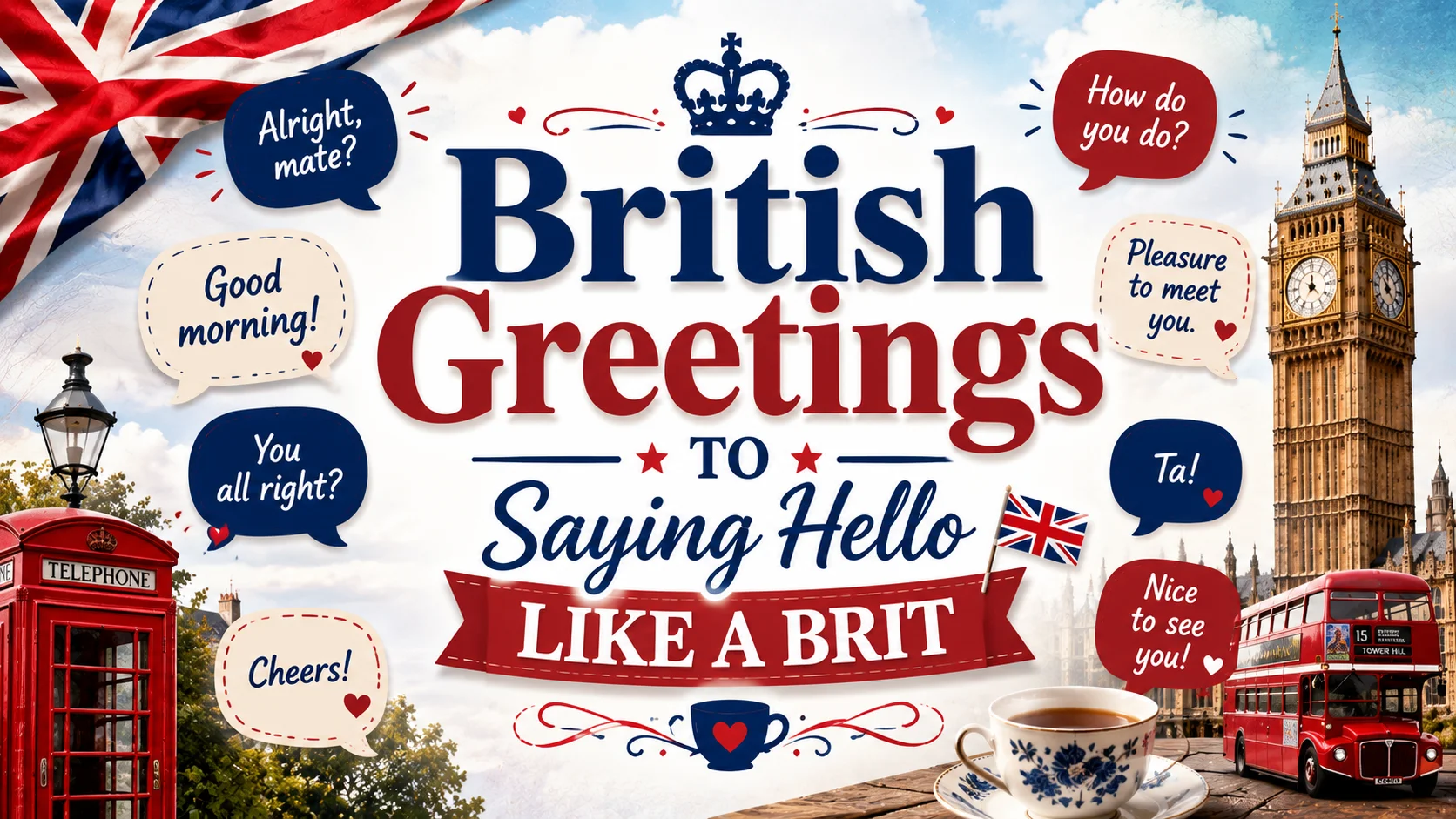
British greetings are famous worldwide for their unique blend of formality, wit, and regional charm. From the crisp “Good morning” to the casual “Alright, mate?”, the way Brits say hello reveals much about their culture, social class, and regional identity. Unlike the more standardized greetings in some cultures, British greetings can range from very formal handshakes to awkward hugs, nods, or simple “Hellos,” creating a delightful social minefield. Whether you’re planning a visit to the UK, connecting with British friends, or simply want to add some British flair to your conversations, learning the nuances of these greetings is both fascinating and essential. This comprehensive guide explores everything from the ancient “How do you do?” to modern slang, regional variations, and the all-important etiquette behind British greetings. So, grab a cuppa, and let’s dive into the wonderfully complex world of British greetings! 🇬🇧☕
The Famous “Alright?” – Britain’s Favorite Greeting 🤝
- “Alright?” is arguably the most common and versatile informal greeting in Britain, equivalent to saying “Hello, how are you?”
- It is pronounced more like “Awright?” or simply “‘Right?” in casual speech.
- Despite sounding like a question about your wellbeing, it is primarily a greeting that doesn’t require a detailed answer about your health.
- The most common response is simply to say “Alright?” back, often accompanied by a nod.
- For a slightly more formal or friendly version, you might hear “Alright, mate?” when addressing a male friend or acquaintance.
- “You alright?” or “You OK?” are also used as informal greetings, typically among friends and family.
- This greeting is so quintessentially British that it’s one of the first things visitors notice and adopt.
- If you want to sound like a local, this is the greeting to master!
- Don’t overthink it—just say “Alright?” back with a nod and a smile.
- The word “alright” is so embedded in British culture that it’s used multiple times throughout the day.
- It’s a perfect example of British understatement and subtlety in communication.
The Formal “How Do You Do?” 🤵
- “How do you do?” is the ultimate formal British greeting, though it is rarely used in modern everyday life.
- This is a greeting, not a question, so the correct response is to repeat “How do you do?” back.
- You’ll typically only encounter this in extremely formal “upper class” settings or during official introductions.
- It is often accompanied by a firm handshake.
- After this initial greeting, the conversation can move on to more conventional small talk.
- You might also hear “Pleased to meet you” or “Delighted to meet you” during formal introductions.
- These are usually said while shaking hands.
- The response is typically “Pleased to meet you too”.
- While “How do you do?” is traditional, it can feel outdated, so using “Nice to meet you” is a safer modern alternative.
- When in doubt about formality, a handshake and a simple “Hello” or “Good morning” is always safe.
- The phrase “How do you do?” is one of the most formal greetings in the English language.
Regional Greetings: From “Ey Up” to “Wotcher” 🗺️
North of England:
- “Ey up” (or “Eh up” or “Ay-up”) is a common informal greeting throughout the Midlands and the North of England, meaning “Hello”.
- It can also be used as an interjection to mean “look at that”.
- You might also hear “How do?” or “Now then!” in Yorkshire as informal greetings.
- “Ta-ra” is a common way to say goodbye in the North.
South of England:
- “Wotcher” (pronounced “woh-cha”) is a traditional, informal greeting heard mostly in the southeast of England, but its use is declining.
- It originates from a contraction of “What cheer?”.
- It is generally a very casual greeting among friends.
- Many younger Brits find it outdated, so it might get you a strange look.
London & Urban Slang:
- In London and other multicultural cities, you’ll hear a variety of influences, including “Wagwan” (What’s going on?) and “Easy?” from the London black community.
- These are very informal and should be used with caution by non-locals, as they carry specific cultural and linguistic contexts.
Scotland & Northern Ireland:
- In Scotland, you may hear “Aye” used as “Yes” and “How?” meaning “Why?” or in greetings.
- “What’s the craic?” is common in Northern Ireland (and the Republic of Ireland), meaning “What’s new with you?”
- Each region of the UK has its own distinct dialect and greeting style.
- Understanding regional variations can help you connect more deeply with locals.
Simple and Safe British Greetings 👍
- “Hi” is universally acceptable and used by everyone at any time, except in extremely formal circumstances.
- “Hello” is the standard, safe, and polite greeting for almost any situation.
- “Hiya” is a more informal and friendly version of “Hi,” commonly used between friends and acquaintances.
- “Hey” has become increasingly popular, influenced by American culture, and is used as a relaxed greeting.
- “Morning!”, “Afternoon!”, or “Evening!” are casual versions of the formal greetings, dropping the “Good”.
- These are widely used and perfectly polite in most social situations.
- “How’s it going?” or “How you doing?” are common, relaxed ways to ask how someone is.
- The response is typically something simple like “Not bad, you?” or “Good, thanks!”.
- These greetings are safe to use with anyone, from strangers to close friends.
- They are the building blocks of any British conversation.
British Greetings Etiquette: Handshakes, Kisses, and Awkwardness 🤝
The Handshake:
- The handshake is the most common form of greeting in Britain.
- It is customary when being introduced to someone new or in a formal business setting.
- A firm handshake is expected, though with a lighter touch between both gender.
- It is always the visitor who offers their hand first.
The “Kiss” Question:
- Kissing on the cheek is not the standard greeting in Britain as it is in some European countries.
- One kiss is usually enough.
- This lack of clear rules is a classic source of British social awkwardness: one person goes in for a hug, the other offers a reserved head nod, and the result is embarrassment for everyone.
- If in doubt, a handshake is the safest option.
Politeness is Key:
- The British are famous for their politeness, and greetings are no exception.
- It is common to greet people in shops and small businesses with a simple “Good morning” or “Hello”.
- People in the countryside and small towns tend to be much friendlier, greeting strangers they pass with a polite “Good morning” or “Good afternoon”.
- British etiquette places a high value on personal space and respect.
Understanding British Politeness in Greetings 🙏
- British politeness is legendary and deeply embedded in greetings.
- The phrase “Sorry” is used as a greeting, an apology, or just a way to get someone’s attention.
- “Excuse me” is also used frequently, often when navigating through crowds or getting someone’s attention.
- The British are known for their indirect communication style.
- Instead of saying “No” directly, they might say “I’m not sure” or “I’ll see what I can do.”
- This indirectness extends to greetings, where even a simple “How are you?” often expects a brief, positive response like “Fine, thanks” rather than a detailed account of your problems.
- Politeness also dictates that you should not be overly familiar with someone you’ve just met.
- Wait for the other person to invite you to use their first name.
- Understanding this nuanced politeness is key to mastering British social interactions.
- A smile and good eye contact are also important signs of politeness in British culture.
British Greetings for Work and Professional Settings 💼
- In professional settings, formal greetings are the norm.
- “Good morning,” “Good afternoon,” or “Good evening” are the standard ways to start a business meeting.
- A firm, brief handshake is the standard physical greeting.
- Titles are very important until invited to be less formal.
- Use “Mr.,” “Mrs.,” “Ms.,” or “Dr.” with the person’s last name.
- The response to a formal greeting is the same greeting back: “Good morning” to “Good morning.”
- First names are typically used only after the more senior person suggests it.
- Business cards are exchanged after introductions, usually with a brief glance.
- Professional greetings should always be accompanied by good eye contact.
- Avoid overly enthusiastic or prolonged greetings in a professional context.
Casual Greetings Among Friends and Family 💕
- Among close friends and family, British greetings become much more relaxed.
- “Alright?” is the most common casual greeting.
- Hugs or a pat on the back are common among male friends.
- Women often greet each other with a hug and a kiss on the cheek.
- “How’s things?” or “What’s new?” are common among friends.
- In some groups, a simple “Hey” or “Hiya” is all that’s needed.
- The response is often just as casual: “Not bad” or “Same old, same old.”
- The British are not big on overly emotional greetings, even among friends.
- A subtle nod or a wave is often enough.
- Even casual greetings show the British reserve and understatement.
- Close friends might use playful nicknames or insults as terms of affection.
British Greetings for Social Gatherings and Pubs 🍻
- When arriving at a social gathering, it is customary to greet everyone present.
- A simple “Hello everyone” or “Hi all” is acceptable.
- In pubs, greeting friends at the bar often involves a nod, a raised hand, or a simple “Alright, mate?”
- When meeting someone new at a social event, a handshake is still the standard.
- It’s common to ask “How do you know [the host]?” as a conversation starter after the initial greeting.
- If you arrive at a pub, it’s polite to ask “What are you having?” if someone offers to buy you a drink.
- The most common toast is simply “Cheers!”
- If someone clinks your glass, make sure to maintain eye contact with them.
- Social greetings in Britain are often followed by comments about the weather.
- “Lovely weather we’re having” is a classic icebreaker.
How to Greet Someone in a Shop or Restaurant 🛍️
- When entering a shop, it is polite to acknowledge the shopkeeper.
- A simple “Hello” or “Good morning” is sufficient.
- The shopkeeper will often respond with “Can I help you?”
- If you are just browsing, you can say “Just looking, thanks.”
- When leaving a shop, it is polite to say “Thank you” or “Cheers”.
- The shopkeeper will often respond with “Thanks” or “See you later.”
- In restaurants, greetings are usually performed by the waiting staff.
- They will often say “Good evening, welcome to [restaurant name].”
- You can respond with a simple “Hello” or “Good evening.”
- It is polite to say “Thank you” when the waiter shows you to your table.
- These interactions are brief but important.
British Greetings on the Phone and in Texts 📱
- On the phone, it is still common to answer with “Hello” or the phone number.
- In professional settings, you might answer with “[Company name], [Your name] speaking.”
- In informal calls, you might hear “Alright?” or “Hiya.”
- In texts and social media, British greetings are very similar to spoken greetings.
- “Alright?” and “Hey” are very common.
- You might also see “Morning” or “Afternoon” depending on the time of day.
- In British texting, an enquiry after the person’s health is usually expected.
- It’s considered polite to reply to texts within a reasonable time.
- Emojis are used, but less frequently than in many other cultures.
- British texting style is often dry and witty.
Understanding British Small Talk After Greetings 🗣️
- In Britain, greetings are often followed by small talk.
- The most common topic is the weather.
- “Nice day, isn’t it?” or “Cold enough for you?” are classic openers.
- Asking “How are you?” after the initial greeting is also very common.
- The response is expected to be brief and positive: “Fine, thanks. And you?”
- Another common topic is plans for the weekend.
- Asking “What are your plans for the weekend?” is a friendly way to continue a conversation.
- Avoid asking overly personal questions to people you’ve just met.
- The British are generally reserved and value their privacy.
- Complaining about minor inconveniences is a favorite British pastime.
- “The trains are never on time, are they?” is a classic conversation starter.
The Role of Humor in British Greetings 😂
- Humor is at the heart of British culture, and it’s often woven into everyday greetings.
- A typical British greeting might include a witty remark or a playful tease.
- The British love to use self-deprecating humor, often making fun of themselves.
- Greetings like “Not dead yet, then?” are often said with a smile and a wink.
- The British use humor to break the ice and make others feel comfortable.
- A common response to “How are you?” might be “Mustn’t grumble.”
- British humor often involves sarcasm and understatement.
- “It’s a bit fresh today” is a sarcastic way of saying it’s freezing cold.
- When greeting someone, the British might joke about the weather.
- The British use humor to connect with others and create a warm atmosphere.
Differences Between British and American Greetings 🌍
- Formality: British greetings are generally more formal than American ones.
- Physical Contact: The British are more reserved and less likely to hug or kiss than Americans.
- Language: The British use different words for greetings, such as “Cheers” and “Mate.”
- Politeness: The British are famously more polite and indirect than Americans.
- Question Style: A British “How are you?” is often a greeting rather than an actual question.
- American: “How are you?” often expects a longer, more detailed answer.
- British: “Alright?” is often just a way of saying “Hello.”
- American: “What’s up?” is a common casual greeting.
- British: “What’s the craic?” is a common casual greeting in Northern Ireland.
- Understanding these differences is important when communicating with people from different cultures.
British Greetings for Special Occasions 🎉
- Christmas: “Merry Christmas” or “Happy Christmas” are the standard greetings.
- New Year: “Happy New Year” is the standard greeting.
- Birthday: “Happy Birthday” is the standard greeting.
- Weddings: “Congratulations” is the standard greeting to the couple.
- Funerals: “I’m sorry for your loss” is the standard expression of sympathy.
- Religious Holidays: “Happy Easter” or “Happy Ramadan” are appropriate.
- St. Patrick’s Day: “Happy St. Patrick’s Day” is commonly said.
- Bonfire Night: “Happy Bonfire Night” or “Remember, remember the 5th of November” are common sayings.
- Remembrance Day: People often say “We will remember them.”
- Leaving the Office: “See you later” or “Goodbye” is common.
Northern vs. Southern British Greetings 🗺️
Northern England:
- “Ey up” is the classic northern greeting.
- “Now then” is also common in Yorkshire.
- “How do?” is another traditional northern greeting.
- “Ta-ra” is a common farewell in the north.
- Northern greetings are often more open and friendly.
Southern England:
- “Alright?” is very common, often said in a flat tone.
- “Wotcher” is a traditional southern greeting, though less common now.
- “Cheers” is used more widely in the south.
- Southerners are often more reserved in their greetings.
- In London, you’ll hear a wide range of multicultural influences.
- These regional differences are a point of pride for many Brits.
London Slang Greetings: “Wagwan,” “Easy,” and More 🏙️
- “Wagwan” (or “Wag1”) is a slang greeting meaning “What’s going on?”.
- It originates from Jamaican Patois and is commonly used in London’s multicultural communities.
- “Easy, bruv” is another slang greeting meaning “Hello, brother.”
- “Safe” can be used as a greeting, meaning “Hello” or “Goodbye.”
- “How’s your nan?” is a playful London greeting.
- “Leng” is a term used to describe something or someone as attractive.
- “Dry” is a term used to describe something or someone as unfunny or boring.
- These phrases should be used with caution by non-locals.
- They carry specific cultural and linguistic contexts.
- Using them incorrectly can make you sound inauthentic.
Saying Goodbye in British Style 👋
- “Cheerio” is a traditional, slightly old-fashioned British goodbye.
- “Ta-ta” is an informal farewell, often used in the north.
- “See you later” is the most common and informal goodbye.
- “Catch you later” is a casual, modern version.
- “Take care” is a warm way to say goodbye.
- “Have a good one” is a friendly, informal farewell.
- “Bye for now” is a friendly way to indicate you’ll see them again.
- “Later” is a very short, informal goodbye.
- “Peace” is used by younger generations.
- The British often say “Cheers” as a farewell, implying “Thanks and goodbye.”
Useful British Phrases for Travelers 🧳
- “Excuse me, where is the loo?” – Asking for the toilet.
- “How much is that?” – Asking for the price.
- “Can I get a coffee, please?” – Ordering in a café.
- “What’s the time?” – Asking for the time.
- “I’m lost, can you help me?” – Asking for directions.
- “I’m looking for the train station.” – Asking for directions.
- “Could you speak more slowly?” – Asking someone to speak slower.
- “Thank you very much.” – Saying thanks.
- “I’m sorry.” – Apologizing.
- “Cheers.” – Saying thank you.
- “Mate” and “Love” – terms of address.
- “Alright?” – A common greeting.
Closing Thoughts on British Greetings 🇬🇧
- British greetings are a fascinating reflection of the culture: polite, witty, and often understated.
- Mastering them takes practice and observation.
- The most important thing is to be polite and respectful.
- A smile and a friendly “Hello” will always be appreciated.
- Regional variations add a rich layer of diversity.
- Understanding the difference between formal and informal greetings is key.
- British greetings are constantly evolving with language and culture.
- The British are generally patient with non-natives who make an effort.
- So, go ahead and give it a go – you might just get a “Good on ya!” in return.
- And remember: “A good laugh is sunshine in the house.”
❓ Frequently Asked Questions About British Greetings
What is the most common British greeting?
The most common informal greeting is “Alright?” or “You alright?”, which serves as a simple way to say hello.
What does “Alright, mate?” mean?
It means “Hello, friend,” and is a very informal and friendly British greeting.
How do you respond to “Alright?”?
The most common response is to simply say “Alright?” back, often with a nod.
What is the difference between “How do you do?” and “How are you?”?
“How do you do?” is a very formal greeting used upon first introduction, and the correct response is to repeat it. “How are you?” is a question asking about someone’s wellbeing and requires a response like “I’m fine, thanks”.
Do British people say “Cheers” for thanks?
Yes, “cheers” is a very common, informal way to say “thank you” in the UK.
What does “Ta” mean?
“Ta” is an informal British way of saying “thank you”.
How do you say goodbye in British slang?
Common ways include “See ya,” “Catch you later,” “Take it easy,” and “Cheers”.
Do Brits actually say “Top of the morning”?
No, this is an Irish-American stereotype and not commonly used in Britain.
Is it common to kiss on the cheek in Britain?
No, cheek-kissing is not the standard greeting in Britain. It is mostly reserved for close friends or family.
What is “Ey up”?
“Ey up” (or “Eh up”) is an informal greeting common in the Midlands and North of England, meaning “Hello”.
What is “Wotcher”?
“Wotcher” is a traditional, informal greeting from the southeast of England, though its use is declining.
What is the most polite British greeting?
In formal situations, “Good morning/afternoon/evening” with a handshake is the most polite.
Should I hug when greeting a Brit?
Hugging is generally reserved for close friends and family. When in doubt, a handshake is safer.
What does “How’s it going?” mean?
It’s a casual way of asking “How are you?” and is a common greeting.
What is the response to “How do you do?”
The correct response is to repeat “How do you do?”.
What is “Alright, love?”
A friendly, informal greeting, often used by shopkeepers or in the North of England when addressing a woman.
What does “Now then!” mean in Yorkshire?
It is a common and friendly way of saying “Hello” in Yorkshire.
What should I say when entering a shop in the UK?
A simple “Hello” or “Good morning/afternoon” is polite and customary.
What does “Easy, bruv” mean?
It is a very informal London greeting, meaning “Hello, brother,” and should be used with caution by non-locals.
What is the most British word?
While many would argue it’s a full word, “Cheers” and “Mate” are strong contenders for the most quintessentially British expressions.
Conclusion: Mastering the Art of British Greetings 🇬🇧✨
British greetings are a fascinating window into the UK’s unique culture, blending centuries of tradition with modern, regional, and global influences. From the formal elegance of a handshake to the casual charm of “Alright, mate?”, these British phrases reflect a society that values politeness, wit, and a good dose of social awkwardness. Whether you’re navigating the minefield of when to hug, perfecting your use of “Cheers” for thanks, or experimenting with regional slang like “Ey up,” your efforts to speak like a local will be met with a warm British welcome. The key to success is to adapt to the situation, observe the locals, and remember: the most important thing is to greet people with a smile and a friendly attitude. So, go ahead and give it a go – you might even get a “Good on ya!” in return. ☕🇬🇧