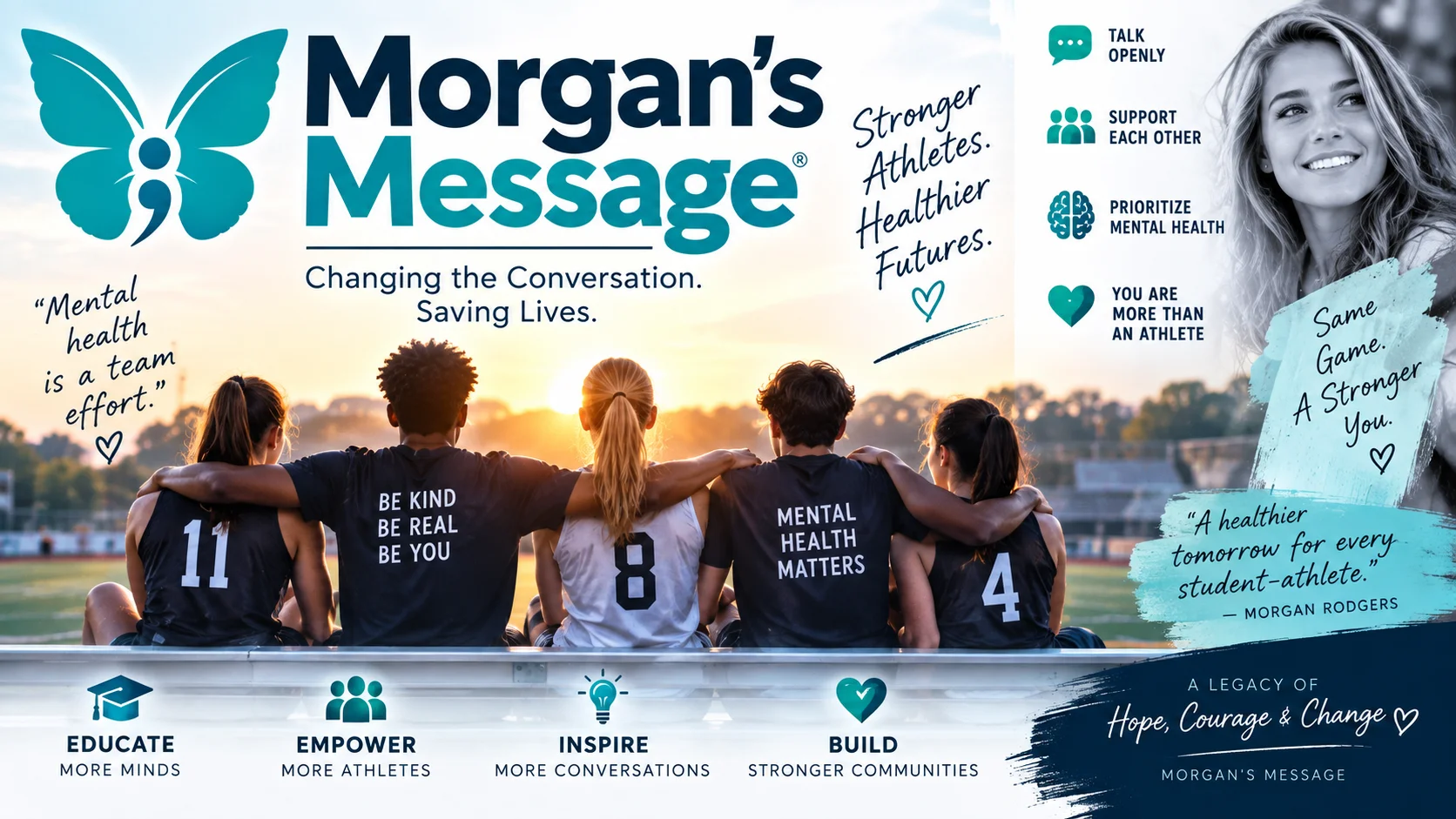
Morgan’s Message is a nonprofit organization focused on changing the conversation around mental health in the student-athlete community. Its work encourages athletes to speak openly about emotional struggles, seek support, and understand that mental health deserves the same attention as physical health.
For many student-athletes, sports can bring confidence, friendship, discipline, and a strong sense of purpose. At the same time, athletes can experience pressure, injuries, expectations, isolation, burnout, and other challenges that are not always visible from the outside. Morgan’s Message aims to create spaces where these experiences can be discussed without shame.
The organization combines mental health education, peer-to-peer conversations, advocacy, storytelling, and community involvement. Its programs include student-athlete ambassadors, at-large ambassadors, and opportunities for club and youth sports organizations to bring mental health conversations into their communities.
Morgan’s Message also provides a platform for athletes to share personal experiences through The Mental Matchup, a podcast and story series focused on the mental health journeys of athletes. The goal is simple but important: help people feel less alone and make conversations about mental health more normal.
🦋 What Is Morgan’s Message?
Morgan’s Message is a nonprofit organization dedicated to student-athlete mental health. It works to reduce the stigma surrounding mental health and encourage athletes to talk openly about their experiences.
The organization focuses on creating supportive communities where athletes can discuss topics such as stress, pressure, emotional well-being, injuries, identity, performance expectations, and other personal challenges.
Rather than treating mental health as something separate from athletic life, Morgan’s Message promotes a broader view of the athlete. An athlete can be competitive and ambitious while also experiencing difficult emotions or needing support.
💚 What Is the Mission of Morgan’s Message?
The mission of Morgan’s Message centers on strengthening student-athlete mental health through stories, resources, expertise, peer-to-peer conversations, and advocacy.
Its vision includes eliminating mental health stigma in high school and collegiate athletics, normalizing conversations, encouraging peer communication, and supporting people who may feel alone.
This approach recognizes that asking for help should not be viewed as weakness. Mental well-being is an important part of being a healthy and complete athlete.
🏃 Why Is Student-Athlete Mental Health Important?
Student-athletes often balance multiple responsibilities at the same time. They may be managing schoolwork, practices, competitions, relationships, social expectations, and personal goals.
An injury can make these pressures even more complicated. When an athlete cannot participate in the sport that forms a major part of their identity, they may experience frustration, loneliness, uncertainty, or a loss of confidence.
Mental health conversations give athletes an opportunity to recognize these feelings and reach out for appropriate support. Creating a culture where people can speak honestly can also help teammates recognize that they are not alone.
🌿 The Story Behind Morgan’s Message
Morgan’s Message was created in memory of Morgan D. Rodgers, a former Duke University lacrosse player. Her experience and legacy became the foundation for an organization dedicated to changing how student-athletes and athletic communities approach mental health.
Her story helped inspire a larger conversation about what can happen when athletes feel pressure to remain strong and silent while struggling internally.
The organization carries that message forward by encouraging people to talk, listen, support one another, and seek help when needed.
💬 Why Talking About Mental Health Matters
Silence can make emotional struggles feel even more isolating. When people believe they are the only ones experiencing anxiety, sadness, pressure, disappointment, or other difficult emotions, they may hesitate to tell anyone.
Open conversations can change that experience.
When teammates, coaches, parents, schools, and athletic programs create safe opportunities for discussion, athletes may feel more comfortable asking questions or sharing what they are experiencing.
A simple conversation can also remind someone that needing support does not make them less capable or less committed to their sport.
🎙️ What Is The Mental Matchup?
The Mental Matchup is a podcast and story series connected with Morgan’s Message. It shares stories about the mental health journeys of athletes and creates space for honest conversations.
The stories cover different experiences and perspectives, helping listeners understand that mental health challenges can affect athletes in many different ways.
Personal storytelling can be powerful because it turns an abstract topic into something human and relatable. Hearing another athlete say, “I experienced something similar,” can help someone feel understood.
🎓 Morgan’s Message Student-Athlete Ambassadors
The Student-Athlete Campus Ambassador Program gives eligible high school and college students an opportunity to become mental health advocates within their communities.
Ambassadors can help organize conversations, activities, events, and awareness efforts on their campuses. The program emphasizes peer-to-peer communication, allowing students to help create a culture where mental health discussions feel more normal.
This model is especially valuable because students often understand the pressures their peers experience in ways that adults may not immediately recognize.
🤝 How Peer-to-Peer Support Can Help
Peer support does not replace professional mental health care, but it can make conversations feel easier to begin.
A teammate who listens without judgment can help someone feel less isolated. A friend who encourages another athlete to speak with a counselor can help connect them with additional support.
Morgan’s Message emphasizes this type of community-based conversation because mental health awareness is not only the responsibility of one person. Coaches, teammates, schools, families, and athletic organizations can all contribute to a healthier environment.
🏫 Morgan’s Message in High School and College Athletics
Mental health conversations can be especially important during high school and college years. Student-athletes are often navigating major academic, athletic, social, and personal transitions.
Morgan’s Message provides educational and ambassador opportunities designed for these communities. Student-athlete ambassadors can help bring mental health awareness directly to their campuses.
The goal is not simply to hold one awareness event. It is to help create an ongoing culture in which athletes can talk about mental health throughout the year.
🌎 Morgan’s Message At-Large Ambassador Program
Morgan’s Message also offers an At-Large Ambassador Program for adults who are not current student-athletes.
This broader community includes people such as former student-athletes, parents, athletic staff, mental health advocates, and other supporters.
The program allows people with different experiences to participate in mental health advocacy and help spread the organization’s message within their communities.
🏅 Mental Health and Athletic Performance
Mental and physical health are closely connected to an athlete’s overall well-being. Training, competition, injury recovery, sleep, stress, confidence, and emotional health can all influence an athlete’s experience.
That does not mean every emotional struggle is caused by sports. Instead, it means athletic environments should recognize the whole person rather than focusing only on performance.
A healthy athletic culture can encourage athletes to care about their bodies, minds, relationships, and long-term well-being.
🗣️ How Coaches Can Encourage Mental Health Conversations
Coaches have an important role in shaping team culture. They can encourage open communication by showing athletes that asking for help is acceptable.
Simple actions can make a difference. Coaches can listen carefully, avoid dismissing emotional concerns, provide information about available resources, and encourage athletes to seek qualified professional support when appropriate.
The strongest teams are not necessarily those where nobody struggles. They can also be teams where people feel safe enough to admit when they need help.
👨👩👧 How Parents Can Support Student-Athletes
Parents can support young athletes by creating an environment where success is not the only measure of worth.
Instead of focusing only on scores, statistics, scholarships, or playing time, parents can ask how their child is actually feeling.
Questions such as “How are you doing?” or “Is there anything you want to talk about?” can open a door without forcing the athlete to share more than they are comfortable discussing.
Listening without immediately judging or solving the problem can also make difficult conversations easier.
🌸 You Are More Than an Athlete
One of the most meaningful ideas connected with Morgan’s Message is that athletes are more than their sports identity.
An athlete can also be a daughter, son, sibling, friend, student, artist, volunteer, teammate, or many other things.
When an athlete experiences an injury, loses playing time, changes teams, or eventually finishes a sports career, their identity does not disappear.
Remembering this can help create a healthier relationship with sport and performance.
🦋 The Meaning Behind the Morgan’s Message Butterfly
The butterfly has special meaning within Morgan’s Message. According to the organization, its butterfly logo was inspired by Morgan’s artwork, her love of teal, and butterflies that appeared around her memorial.
The logo also includes a semicolon, which the organization describes as a symbol of affirmation and solidarity related to suicide, depression, addiction, and other mental health challenges.
The butterfly therefore represents more than a visual identity. It connects the organization with Morgan’s memory, love, hope, and its continuing mental health advocacy.
📚 Mental Health Education for Athletes
Education can help athletes understand that mental health is a normal part of overall well-being.
Mental health education can cover topics such as recognizing emotional distress, reducing stigma, supporting teammates, understanding available resources, and knowing when professional assistance may be appropriate.
Programs that bring these discussions into athletic environments can make mental health easier to discuss before someone reaches a crisis point.
🌟 Why Morgan’s Message Matters
Morgan’s Message matters because student-athletes deserve environments where their mental well-being is taken seriously.
Winning a game, earning a starting position, or reaching a championship can be meaningful achievements. But those achievements should not come at the cost of someone’s health.
By encouraging conversations, sharing stories, and creating peer-led communities, Morgan’s Message helps challenge the idea that athletes must always appear mentally strong.
Strength can also mean admitting that something is difficult and being willing to seek support.
💭 What Can We Learn From Morgan’s Message?
The biggest lesson is that people should not have to struggle silently.
Athletes can experience difficult emotions even when they appear successful. A person can smile during practice and still be struggling privately.
Creating space for honest conversations can help remove some of the shame surrounding mental health.
Morgan’s Message reminds athletic communities that supporting mental health is not about making athletes less competitive. It is about helping them become healthier, more supported people both inside and outside their sport.
❓ Frequently Asked Questions About Morgan’s Message
1. What is Morgan’s Message?
Morgan’s Message is a nonprofit organization focused on student-athlete mental health. It works to reduce mental health stigma, encourage open conversations, support peer-to-peer communication, and provide resources and advocacy for athletic communities.
2. What is the mission of Morgan’s Message?
The mission of Morgan’s Message is to strengthen student-athlete mental health through stories, resources, expertise, peer-to-peer conversations, and advocacy. The organization also works toward normalizing mental health discussions in athletic communities.
3. Who was Morgan Rodgers?
Morgan D. Rodgers was a former Duke University lacrosse player whose life and experiences inspired the creation of Morgan’s Message. The organization was established in her memory to encourage better mental health conversations among student-athletes.
4. What is The Mental Matchup?
The Mental Matchup is a podcast and story series associated with Morgan’s Message. It shares mental health journeys and experiences from athletes while creating a space for honest conversations about emotional well-being.
5. Who can become a Morgan’s Message student-athlete ambassador?
The Student-Athlete Campus Ambassador Program is designed for current high school and college student-athletes who meet the program’s eligibility requirements. Ambassadors help promote mental health awareness and peer-to-peer conversations within their communities.
6. Can adults participate in Morgan’s Message?
Yes. Morgan’s Message has an At-Large Ambassador Program for adults who are not current student-athletes. It includes groups such as former student-athletes, parents, athletic staff, and mental health advocates.
7. Why is mental health important for student-athletes?
Student-athletes can experience pressure from academics, competition, injuries, expectations, relationships, and performance. Mental health support can help create healthier athletic environments where athletes feel comfortable discussing challenges and seeking appropriate help.
8. What does the Morgan’s Message butterfly represent?
The butterfly logo has a personal connection to Morgan’s artwork, her love of teal, and butterflies noticed around her memorial. The organization also uses a semicolon in its logo as a symbol of affirmation and solidarity around mental health challenges.
🌷 Conclusion
Morgan’s Message represents an important effort to make mental health conversations more open within athletic communities. Its work reminds student-athletes that they are people first and that their emotional well-being deserves attention alongside physical performance.
Through peer conversations, education, storytelling, advocacy, and community involvement, the organization encourages athletes and the people around them to speak openly, listen without judgment, and support one another.
The message is simple but powerful: an athlete does not have to struggle alone. Asking for help is not a failure, and taking care of mental health is an important part of becoming a healthier person and athlete.