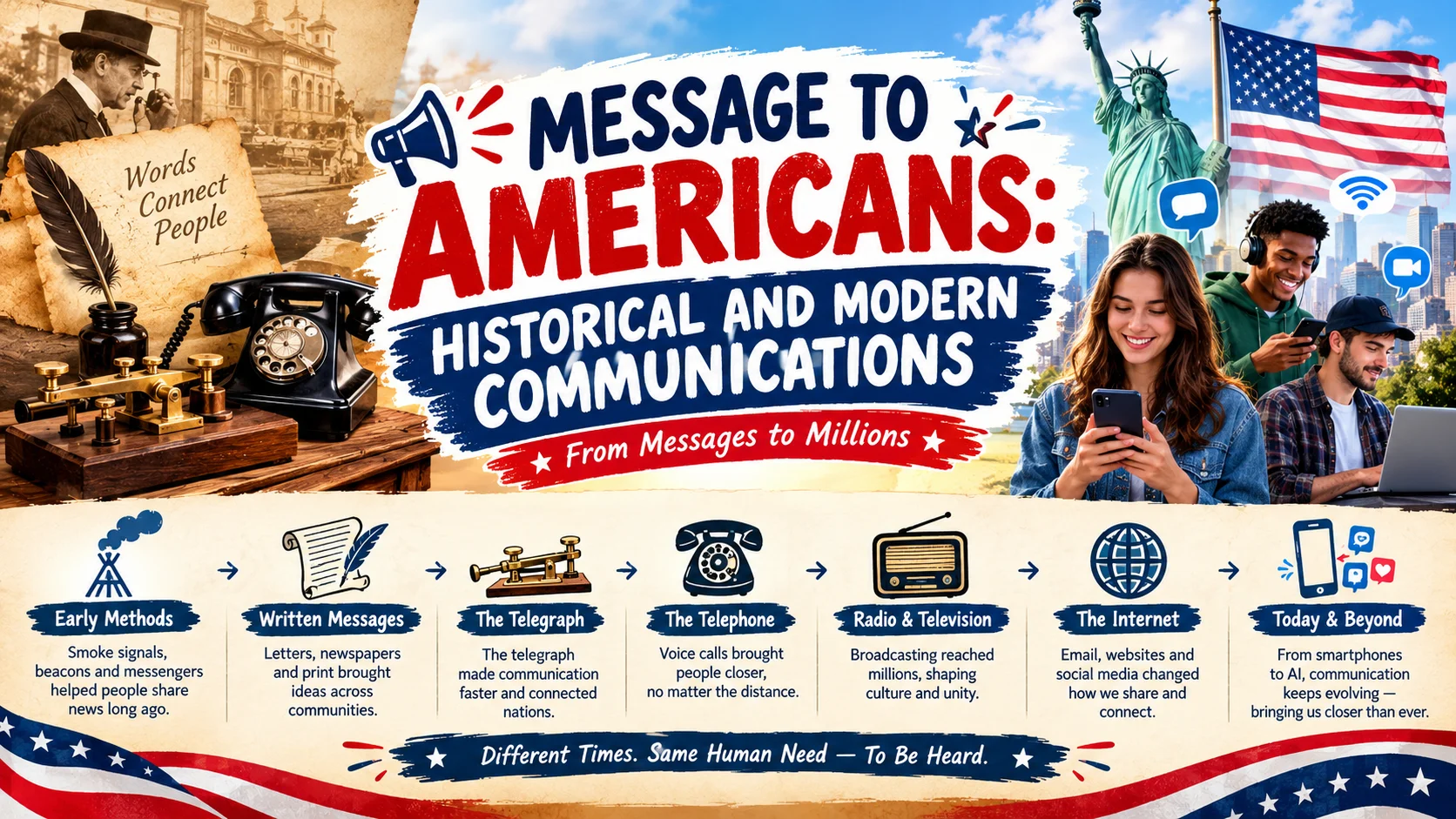
Throughout American history, powerful messages have shaped the nation’s identity, guided its citizens through crises, and defined its role in the world. From presidential addresses that rallied a nation during wartime to international leaders who called for partnership and shared values, these communications have left an indelible mark on the American psyche. Today, as Americans face a complex landscape of economic challenges, political polarization, and global uncertainties, these messages carry renewed significance and urgency.
Understanding the messages that have been delivered to Americans—by their own leaders and by global figures—provides valuable insight into the nation’s character, values, and challenges. Whether it is Franklin D. Roosevelt’s final call for lasting peace, Nelson Mandela’s plea for partnership, or modern warnings about economic pressures, each message reflects the hopes, fears, and aspirations of its time. This comprehensive guide explores the most significant messages to Americans throughout history and offers guidance on how to craft meaningful communications for today’s diverse American audience.
The Historical Significance of Messages to Americans
Messages delivered to the American people have played a pivotal role in shaping national identity, guiding public opinion, and uniting citizens during times of crisis.
- Presidential addresses have served as defining moments in American history, often delivered during times of war, economic depression, or social upheaval.
- These messages have the power to inspire, comfort, and challenge the nation, setting the course for future generations.
- Historical messages to Americans reflect the values, fears, and aspirations of their time, providing a window into the nation’s soul.
- From George Washington’s Farewell Address to Abraham Lincoln’s Gettysburg Address, these communications have become part of the American canon.
- Messages from global leaders have also shaped American foreign policy and international relations.
- The words of Winston Churchill, Nelson Mandela, and other world leaders have influenced American attitudes toward global issues.
- Understanding these messages helps Americans appreciate their nation’s history and its role in the world.
- These communications remind citizens of the principles upon which the nation was founded.
- They also highlight the challenges that Americans have overcome throughout their history.
- Messages to Americans often call for unity, sacrifice, and a commitment to shared values.
- They serve as a reminder of the responsibilities that come with freedom and democracy.
- Historical messages can inspire present-day Americans to address contemporary challenges.
- They provide a sense of continuity and connection to the nation’s past.
- These communications often become part of the collective memory of the American people.
- Studying them helps citizens understand the evolution of American identity and values.
Franklin D. Roosevelt’s Final Message to Americans
Franklin D. Roosevelt’s last message, prepared on the morning of April 12, 1945, hours before his death, stands as one of the most poignant and powerful communications in American history.
- Roosevelt’s final message was a powerful call for lasting peace, urging Americans to “cultivate the science of human relationships” and work toward “an end to the beginnings of all wars.”
- He framed America’s global responsibility as a direct legacy of Thomas Jefferson’s vision, declaring that “great power involves great responsibility.”
- Roosevelt warned that the nation could not escape the consequences of global aggression and must take an active role in building a peaceful world.
- His closing words—”The only limit to our realization of tomorrow will be our doubts of today”—were meant to rally the nation toward building an enduring peace after World War II.
- The message was never delivered in person, as Roosevelt died that afternoon at Warm Springs, Georgia.
- Despite his death, the message was published and read by Americans across the nation.
- It reflected Roosevelt’s deep commitment to international cooperation and collective security.
- The message also emphasized the importance of human relationships in achieving lasting peace.
- Roosevelt believed that Americans must work together with other nations to prevent future conflicts.
- His words continue to resonate today as the world faces new challenges to peace and stability.
- The message is remembered as a testament to Roosevelt’s vision and leadership.
- It also serves as a reminder of the importance of diplomacy and international cooperation.
- Roosevelt’s final words have been quoted by leaders around the world.
- They remain a source of inspiration for those working toward peace and justice.
- The message is a powerful reminder that great power comes with great responsibility.
Nelson Mandela’s Message to the American People
In June 1990, Nelson Mandela delivered a historic message to the American people, calling for partnership and shared values in the fight against apartheid.
- Mandela addressed U.S. business leaders, calling for a “partnership of freedom and prosperity” between South Africa and the United States.
- He emphasized that the fundamental principles of freedom he sought for South Africa were “not different from those which you hold dear in this country.”
- Mandela highlighted the importance of the right to vote, protection of basic human rights, and equality before the law.
- He urged American businesses to help isolate apartheid South Africa through economic sanctions and divestment.
- Mandela also called for investment in a post-apartheid South Africa to address massive poverty and inequality.
- He warned that “the very stability of the political settlement depends on rapid and visible progress being made to improve the quality of life of all the people.”
- Mandela’s message was a powerful reminder of the interconnectedness of freedom struggles around the world.
- He appealed to America’s founding ideals of liberty, equality, and justice for all.
- The message helped galvanize support for the anti-apartheid movement in the United States.
- Mandela’s words also encouraged American businesses to reconsider their investments in South Africa.
- The message was widely covered by American media, amplifying its impact.
- It strengthened the bond between the American civil rights movement and the anti-apartheid struggle.
- Mandela’s message reflected his vision of a united, democratic, and non-racial South Africa.
- It also highlighted the role that Americans could play in promoting justice abroad.
- The message remains a powerful example of international solidarity and shared values.
Jean Cocteau’s Letter to the Americans
In 1949, French artist and writer Jean Cocteau spent twenty days in New York and composed Letter to the Americans, an essay that captured his vivid impressions of American culture.
- Cocteau praised America’s buoyant hopes and its spirit of optimism and innovation.
- He was struck by the energy and dynamism of American life, which he saw as a source of inspiration.
- However, Cocteau also warned of challenges the nation would need to confront, including “hypocrisy, sexism, racism, and hegemonic aspirations.”
- His observations were remarkably prescient and remain “as timely and urgent as when it was first published” over seventy years ago.
- Cocteau’s letter reflected a European perspective on American culture and society.
- He admired American creativity and its contributions to art, literature, and music.
- At the same time, he critiqued American materialism and its focus on consumerism.
- Cocteau also commented on American politics and its role in the post-war world.
- He urged Americans to live up to their ideals and to address the contradictions in their society.
- His letter was both a celebration and a critique of American culture.
- It highlighted the tension between America’s promise and its reality.
- Cocteau’s words resonated with many Americans who shared his concerns.
- The letter became a classic of cross-cultural commentary.
- It continues to be studied as an example of how outsiders view American society.
- Cocteau’s message reminds Americans of the importance of self-reflection and growth.
Messages from Indian Presidents to Americans
Indian presidents have also delivered messages to the American people, emphasizing shared democratic values and global cooperation.
- In May 2022, India’s President Ram Nath Kovind delivered a farewell address reflecting on democratic values, emphasizing justice, liberty, equality, and fraternity as essential principles for any democracy to endure.
- Kovind reminded citizens that “political democracy cannot last unless there lies at the base of it, social democracy,” a principle that resonates universally, including for American democracy.
- The Indian President also highlighted environmental stewardship, noting that “Mother Nature is in deep agony and the climate crisis can endanger the very future of this planet.”
- His message transcended national boundaries, calling for global cooperation on climate change.
- Kovind emphasized the importance of dialogue and mutual respect in international relations.
- He praised the strong ties between India and the United States, rooted in shared democratic values.
- The message reflected India’s commitment to global peace and stability.
- Kovind also called for greater attention to social justice and equality.
- His words were seen as a call to action for both Indian and American citizens.
- The message highlighted the interconnectedness of the world’s democracies.
- Kovind’s farewell address was widely covered in both Indian and American media.
- It served as a reminder of the responsibilities that come with democratic governance.
- The message also emphasized the importance of environmental sustainability.
- Kovind’s words resonated with Americans concerned about climate change.
- The message reinforced the bond between two of the world’s largest democracies.
Oil Executives’ Economic Warnings to Americans
In recent months, oil executives have issued stark warnings to Americans about rising gasoline prices and the economic challenges ahead.
- Exxon Mobil senior vice president Neil Chapman has warned that benchmark Brent crude could reach $150 to $160 per barrel if inventory declines continue.
- American Petroleum Institute CEO Mike Sommers is “sounding the alarm on these inventories going to record lows.”
- The national average gas price stood at $4.26 in mid-June 2026—$1.28 higher than before the conflict in the Strait of Hormuz began.
- GasBuddy has projected the most expensive summer at the pump in years, putting pressure on American families.
- Oil executives argue that global petroleum inventories are hitting “tank bottom,” with supplies down about 500 million barrels since conflict began.
- White House officials have responded cautiously, warning that publicizing such predictions risks becoming a “self-fulfilling prophecy.”
- Industry executives counter that “the safest message right now is to prepare Americans for higher prices.”
- The warnings have sparked debate about energy policy and national security.
- Some critics argue that oil companies are profiting from high prices at the expense of consumers.
- Others point to global supply chain disruptions and geopolitical tensions as the primary causes.
- The situation has renewed calls for investment in renewable energy and energy independence.
- American families are feeling the pinch of higher gas prices and inflation.
- The warnings have also raised concerns about the broader economic impact.
- Policymakers are under pressure to address rising costs and protect consumers.
- The debate highlights the complex interplay of energy, economics, and geopolitics.
Vice President JD Vance’s Family-Focused Message
Vice President JD Vance has recently addressed Americans with a message about the importance of family and the challenges facing young parents.
- Vance admitted that his controversial “childless cat ladies” comment was “dumb” phrasing that “pissed so many people off that it turned off the thinking part of their brain.”
- He clarified that his actual point was that the country had become “very hostile to families, especially families with young kids.”
- Vance cited attitudes toward young parents in public spaces and pandemic-era mask mandates for toddlers as examples of this hostility.
- His message was intended to draw attention to the challenges facing American families.
- Vance argued that the country needs to become more supportive of parents and children.
- He acknowledged that his phrasing was poorly chosen and distracted from his intended message.
- The Vice President’s comments have sparked debate about family policy and cultural attitudes.
- Some have praised his focus on family issues, while others have criticized his rhetoric.
- Vance’s message reflects broader concerns about declining birth rates and family formation.
- He has called for policies that support working parents and reduce the cost of childcare.
- The Vice President’s message has resonated with many American families.
- He has emphasized the importance of creating a society that values children and parents.
- Vance’s comments have also drawn attention to the need for paid parental leave.
- The message has become part of a larger conversation about work-life balance.
- Vance continues to advocate for policies that strengthen American families.
White House Economic Messaging
The White House has delivered its own messages to Americans about the economy, balancing caution with optimism.
- White House spokesperson Taylor Rogers has offered an optimistic prediction that gas prices would “drop back to multi-year lows” once the conflict in the Strait of Hormuz reaches a successful end.
- White House officials have also warned against publicizing dire economic predictions, fearing they could become self-fulfilling prophecies.
- The administration has emphasized its commitment to addressing rising costs and protecting consumers.
- President Trump has taken credit for lowering energy prices during his first term and has blamed his successor for rising costs.
- The White House has called for increased domestic energy production to reduce reliance on foreign oil.
- Administration officials have also promoted investments in renewable energy as a long-term solution.
- The White House’s message has been shaped by political considerations and electoral pressures.
- Officials are working to reassure Americans that the economy remains strong.
- However, they have also acknowledged the challenges posed by inflation and global supply chain disruptions.
- The administration has urged Americans to remain patient and trust in the government’s ability to address economic challenges.
- The White House has also emphasized the importance of international cooperation in stabilizing energy markets.
- Officials have called on oil-producing nations to increase production to lower prices.
- The administration’s message has been met with skepticism from some critics.
- However, the White House continues to project confidence in the nation’s economic future.
- The message reflects the administration’s broader strategy of balancing optimism with realism.
Messages from American Historical Figures
Throughout history, American leaders have delivered messages that continue to inspire and guide the nation.
- George Washington’s Farewell Address warned against political factions and foreign entanglements, setting a course for American foreign policy.
- Abraham Lincoln’s Gettysburg Address redefined the nation’s purpose, calling for a “new birth of freedom” and government “of the people, by the people, for the people.”
- Thomas Jefferson’s Declaration of Independence articulated the principles of liberty, equality, and self-governance that have defined the American experiment.
- Martin Luther King Jr.’s “I Have a Dream” speech called for racial justice and equality, inspiring generations of Americans to fight for civil rights.
- John F. Kennedy’s inaugural address urged Americans to “ask not what your country can do for you—ask what you can do for your country.”
- Ronald Reagan’s “Tear Down This Wall” speech challenged the Soviet Union and called for the end of the Cold War.
- Franklin D. Roosevelt’s “Four Freedoms” speech articulated the principles of freedom of speech, freedom of worship, freedom from want, and freedom from fear.
- These messages have become part of the American canon, shaping national identity and values.
- They continue to inspire Americans to strive for a more perfect union.
- Each message reflects the challenges and aspirations of its time.
- They serve as a reminder of the nation’s founding principles and its ongoing journey toward justice and equality.
- These messages are studied in schools and referenced in public discourse.
- They have shaped the way Americans understand their nation and its place in the world.
- The words of these leaders continue to resonate with citizens today.
- They provide a foundation for addressing contemporary challenges.
The Role of Messages in American Democracy
Messages to Americans play a crucial role in the functioning of American democracy.
- Effective messages inform citizens about important issues and help them make informed decisions.
- They can mobilize public opinion and build support for policy initiatives.
- Messages can also challenge citizens to reflect on their values and priorities.
- In a democracy, communication between leaders and citizens is essential for accountability.
- Messages can foster a sense of national unity and shared purpose.
- They can also expose divisions and spark debate about the nation’s direction.
- The media plays a key role in amplifying and interpreting messages to the public.
- Social media has transformed the way messages are delivered and received.
- Political leaders use a variety of platforms to communicate with Americans.
- Messages can be both formal, such as presidential addresses, and informal, such as tweets and interviews.
- The effectiveness of a message depends on its clarity, sincerity, and relevance.
- Americans have high expectations for their leaders’ communication skills.
- A well-crafted message can inspire, comfort, and guide the nation.
- Poorly delivered messages can undermine trust and confidence.
- The art of crafting messages to Americans is a crucial skill for any leader.
American Values and Identity Messages
Messages to Americans often focus on the nation’s core values and identity.
- Messages frequently reference the ideals of liberty, equality, and justice that are enshrined in the Declaration of Independence.
- They also emphasize the importance of democracy, freedom of speech, and the rule of law.
- Messages often call for national unity and a shared commitment to the nation’s founding principles.
- They can also highlight the diversity of the American people and the strength that comes from this diversity.
- Messages about identity often reflect the nation’s struggles with racism, inequality, and injustice.
- They can also celebrate the nation’s achievements and contributions to the world.
- Messages about American values are often delivered during times of crisis or national celebration.
- They help reinforce a sense of national pride and purpose.
- These messages also remind Americans of their responsibilities as citizens.
- They call on individuals to contribute to the common good.
- Messages about identity often reference the nation’s history and its ongoing journey toward a more perfect union.
- They can be both inspiring and challenging, urging Americans to live up to their ideals.
- The American identity is constantly evolving, and messages reflect this evolution.
- These communications help shape how Americans see themselves and their nation.
- They also influence how the world perceives the United States.
Economic Messages to Americans
Economic messages are a significant part of communications to Americans, addressing issues such as inflation, employment, and prosperity.
- Presidents often deliver messages about the state of the economy, emphasizing growth, job creation, and opportunity.
- Economic messages can also address challenges such as inflation, unemployment, and inequality.
- These messages are often delivered during presidential addresses, press conferences, and interviews.
- They can shape public expectations and confidence in the economy.
- Economic messages are closely watched by financial markets and business leaders.
- They can influence consumer spending and investment decisions.
- Effective economic messages provide reassurance and clarity during uncertain times.
- They can also propose specific policies to address economic challenges.
- Economic messages often highlight the administration’s achievements and goals.
- They can also criticize the policies of political opponents.
- These communications are a key tool for building public support for economic policies.
- They often emphasize the importance of economic growth and opportunity for all Americans.
- Economic messages can also address long-term challenges such as the national debt and climate change.
- They reflect the administration’s economic philosophy and priorities.
- Economic messages are a crucial part of the political discourse in the United States.
Messages About National Security
Messages about national security are a vital part of communications to Americans.
- Presidents often deliver messages about threats to the nation’s security, both foreign and domestic.
- These messages can address issues such as terrorism, cyberattacks, and geopolitical tensions.
- They are often delivered during times of crisis or military conflict.
- National security messages can also provide reassurance and rally public support for defense policies.
- They emphasize the importance of a strong military and robust intelligence capabilities.
- Messages about national security often call for unity and resilience in the face of threats.
- They can also address the sacrifices made by service members and their families.
- These communications often highlight the nation’s commitment to protecting its citizens.
- National security messages can also address the importance of alliances and international cooperation.
- They often emphasize the values of freedom and democracy that the nation seeks to protect.
- These messages can shape public opinion on issues such as defense spending and foreign policy.
- They also address the challenges posed by emerging threats such as climate change and pandemics.
- National security messages are a key tool for building public support for security policies.
- They reflect the nation’s commitment to its security and its role in the world.
- These communications are a crucial part of the relationship between the government and the American people.
Social and Cultural Messages
Social and cultural messages address issues such as diversity, inclusion, and social justice.
- These messages often highlight the importance of equality and opportunity for all Americans.
- They can address issues such as racial justice, gender equality, and LGBTQ+ rights.
- Social messages often reflect the nation’s progress and its ongoing challenges.
- They can be both celebratory and challenging, urging Americans to address inequality.
- Cultural messages often celebrate the nation’s diversity and artistic achievements.
- They can also address the importance of education, healthcare, and social welfare.
- Social messages are often delivered during times of social movement or change.
- They can build public support for policies that promote justice and inclusion.
- These communications also reflect the nation’s values and aspirations.
- They emphasize the importance of community and mutual responsibility.
- Social messages can also address the challenges faced by marginalized communities.
- They often call for empathy, understanding, and respect for all people.
- These messages are a key tool for building a more inclusive society.
- They reflect the nation’s commitment to its founding ideals of liberty and justice for all.
- Social and cultural messages are a vital part of the American discourse.
Messaging Through Media and Technology
The way messages are delivered to Americans has evolved significantly with advances in media and technology.
- In the early days of the nation, messages were delivered through newspapers, pamphlets, and public speeches.
- The advent of radio and television transformed the way leaders communicated with the public.
- Today, the internet and social media have revolutionized political communication.
- Leaders can now reach millions of Americans instantly through platforms like Twitter, Facebook, and YouTube.
- Social media allows for more direct and personal communication with citizens.
- However, it also presents challenges, such as the spread of misinformation and the erosion of trust.
- The 24-hour news cycle has increased the demand for constant communication.
- Leaders must now navigate a complex media landscape to deliver their messages effectively.
- Traditional media, such as newspapers and television, remain important channels.
- However, digital platforms are increasingly dominant in political communication.
- The rise of social media has also given citizens a greater voice in the national conversation.
- Messages can now be shared, commented on, and debated in real-time.
- This has made communication more dynamic but also more polarized.
- The ability to craft effective messages for different platforms is a crucial skill for leaders.
- The evolution of media and technology continues to shape how Americans receive and respond to messages.
Challenges in Crafting Effective Messages
Crafting effective messages to Americans is not without its challenges.
- Leaders must balance clarity with nuance, ensuring their messages are both understandable and accurate.
- They must also navigate a polarized political environment, where messages are often interpreted through partisan lenses.
- The speed of modern communication means that messages are quickly scrutinized and debated.
- Leaders must be prepared to respond to criticism and clarify their positions.
- The prevalence of misinformation makes it difficult to build trust and credibility.
- Effective messages must be tailored to different audiences and platforms.
- Leaders must also consider the emotional impact of their words, especially during times of crisis.
- Crafting messages that resonate with diverse Americans requires cultural sensitivity and awareness.
- Leaders must also be consistent in their messaging to build trust and credibility.
- The pressure to communicate constantly can lead to mistakes and missteps.
- Effective messages require careful planning, research, and testing.
- Leaders must also be prepared to adapt their messages in response to changing circumstances.
- The challenge is to communicate with authenticity and sincerity while navigating complex issues.
- Leaders must also balance the need for transparency with the need for confidentiality.
- Crafting effective messages is both an art and a science.
The Role of Religious Messages to Americans
Religious messages have played a significant role in American history and continue to influence public discourse.
- Many of the nation’s founding fathers were deeply religious and often referenced God and faith in their messages.
- Religious messages have been used to inspire, comfort, and challenge Americans throughout history.
- Presidents often reference faith in their addresses, calling on Americans to seek divine guidance.
- Religious messages can build community and foster a sense of shared purpose.
- They can also be a source of hope and strength during difficult times.
- However, religious messages can also be controversial, particularly in a diverse society.
- Leaders must be mindful of the separation of church and state in their public communications.
- Religious messages can be a powerful tool for building consensus and promoting moral values.
- They often emphasize the importance of compassion, justice, and service to others.
- Religious messages have played a role in social movements, such as the civil rights movement.
- They continue to shape public debates on issues such as abortion, marriage, and family.
- Americans have diverse religious beliefs, and leaders must be inclusive in their messaging.
- Religious messages can be both a source of unity and division.
- They reflect the nation’s deep religious roots and its ongoing spiritual journey.
- The role of religious messages in American public discourse is complex and evolving.
The Future of Messaging to Americans
The way messages are delivered to Americans will continue to evolve in the future.
- Technology will play an increasingly important role in political communication.
- Social media will continue to be a dominant platform for delivering messages.
- Leaders will need to adapt to new platforms and formats to reach diverse audiences.
- The rise of artificial intelligence and data analytics will enable more targeted messaging.
- However, these tools also raise concerns about privacy and manipulation.
- The challenge will be to communicate effectively while maintaining trust and credibility.
- The future of messaging will require greater transparency and authenticity.
- Leaders will need to be more responsive and accountable to the public.
- The media landscape will continue to fragment, making it harder to reach broad audiences.
- However, new technologies will also create opportunities for more direct and personal communication.
- The future of messaging will be shaped by broader trends in technology, politics, and society.
- Leaders will need to be adaptable and innovative in their communication strategies.
- Effective messaging will require a deeper understanding of the needs and concerns of diverse Americans.
- The future of messaging will also require a renewed commitment to truth and accuracy.
- The ability to connect with Americans will remain a crucial skill for leaders.
Frequently Asked Questions (FAQ)
What Was FDR’s Final Message to the American People?
Franklin D. Roosevelt’s last message, prepared on the morning of April 12, 1945, hours before his death, was a call for lasting peace. He urged Americans to “cultivate the science of human relationships” and work toward “an end to the beginnings of all wars.” His famous words—“The only limit to our realization of tomorrow will be our doubts of today”—continue to inspire.
What Did Nelson Mandela Say to Americans?
In June 1990, Nelson Mandela called on American business leaders to form a “partnership of freedom and prosperity” with South Africa. He urged continued pressure on apartheid while also encouraging investment in a future democratic South Africa to address massive poverty and inequality. He emphasized that the fundamental principles of freedom he sought were “not different from those which you hold dear in this country.”
Why Are Oil Executives Warning Americans About Gas Prices?
Oil executives warn that global petroleum inventories are at critically low levels—down about 500 million barrels since the conflict began in the Strait of Hormuz. Exxon has warned prices could reach $150–$160 per barrel if the supply disruption continues. The national average gas price stood at $4.26 in mid-June 2026, $1.28 higher than before the conflict began.
What Did Jean Cocteau Write About Americans?
In Letter to the Americans (1949), Cocteau praised America’s hopeful spirit while warning of challenges including hypocrisy, racism, and hegemonic aspirations. His observations remain relevant to contemporary American discourse and are considered a classic of cross-cultural commentary.
What Is the Significance of Messages to Americans?
Messages to Americans shape national identity, guide public opinion, and unite citizens during times of crisis. They reflect the values, fears, and aspirations of their time and provide a sense of continuity and connection to the nation’s past. They also hold leaders accountable and remind citizens of their responsibilities.
How Have Messages to Americans Evolved Over Time?
Messages have evolved from newspapers and public speeches to radio, television, and now digital and social media. This evolution has made communication more immediate and direct, but also more complex and challengin
Conclusion
Messages to Americans—whether from presidents, global leaders, artists, or industry executives—play a vital role in shaping the nation’s identity, values, and direction. From Franklin D. Roosevelt’s final call for lasting peace to Nelson Mandela’s plea for partnership, from Jean Cocteau’s cultural observations to modern economic warnings, these communications reflect the hopes, fears, and aspirations of their time.
Today, Americans are receiving urgent messages about economic challenges, political polarization, and global uncertainties. Oil executives warn of rising gas prices and the need for preparation. Vice President JD Vance has called attention to the challenges facing young families. The White House offers cautious optimism while acknowledging the difficulties ahead.
As Americans navigate these complex issues, the messages they receive will continue to shape their understanding of the nation’s challenges and opportunities. The principles that have defined American democracy—justice, liberty, equality, and the pursuit of a more perfect union—remain the foundation upon which the nation’s future must be built.
Whether delivered through a presidential address, a social media post, or a letter from a foreign leader, messages to Americans have the power to inspire, comfort, and guide. They remind citizens of their shared values and collective responsibility. They challenge the nation to live up to its ideals and to work toward a brighter future for all.
As we reflect on the messages that have shaped America, we are reminded of the importance of communication in a democracy. The ability to speak truth, to inspire hope, and to call for unity is a precious gift. May the messages we send to one another always reflect the best of who we are and who we aspire to be.