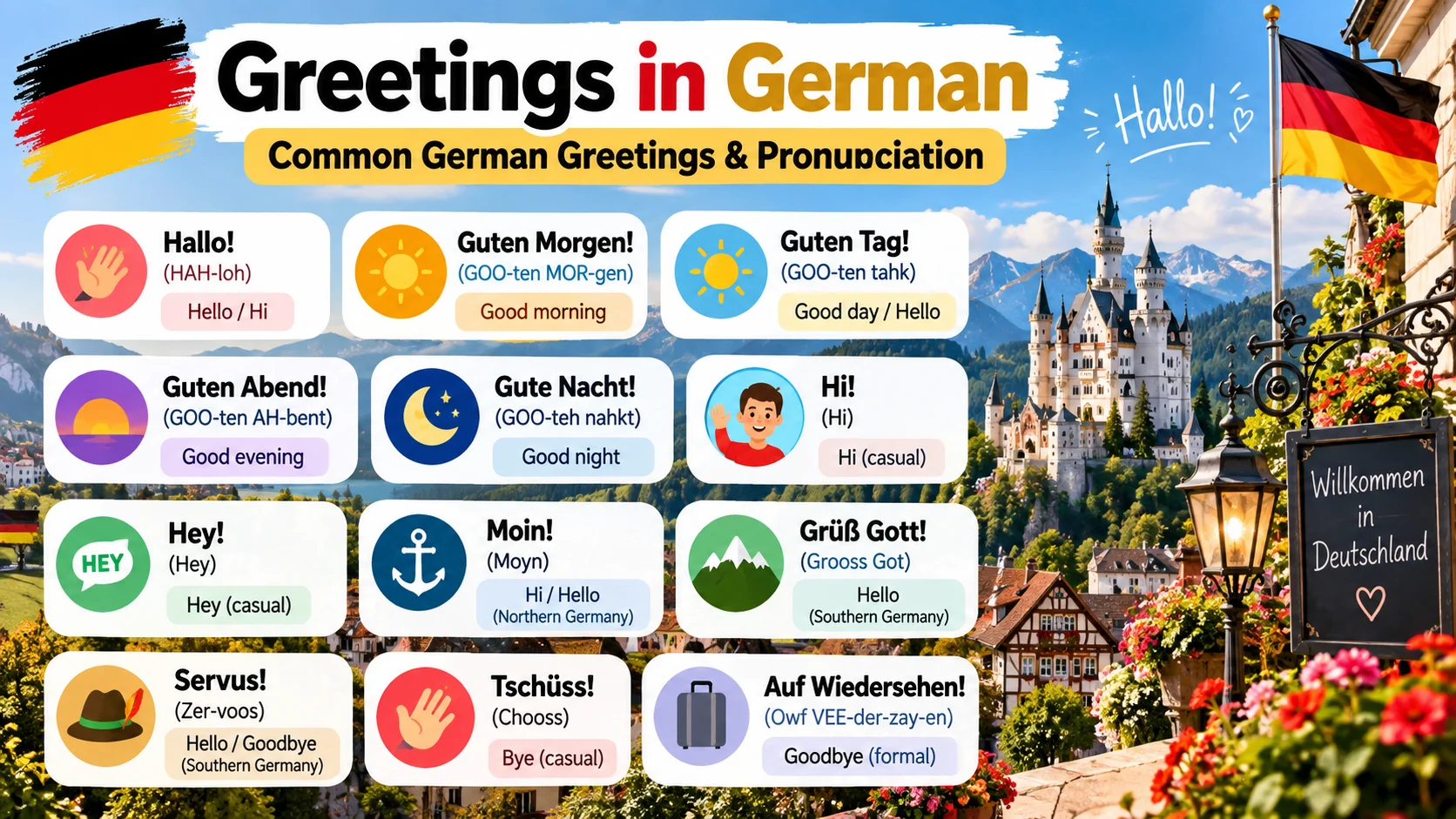
Learning a few greetings in German is one of the easiest ways to start communicating in German. Whether someone is traveling to Germany, meeting German-speaking friends, studying the language, or simply wants to learn a few useful phrases, knowing how to say hello can make everyday conversations much easier.
German greetings change depending on the situation. Some expressions are casual and perfect for friends, while others are more formal and appropriate for workplaces, business conversations, older people, or people someone has just met. Time of day can also affect which greeting sounds most natural.
This guide covers common German greetings, formal and informal greetings, German greetings for morning and evening, ways to say hello in German, pronunciation, responses, farewell expressions, and useful phrases for travelers. Each expression includes its English meaning so it is easy to understand and remember.
👋 What Are Common Greetings in German?
German has several everyday ways to greet someone. Hallo is one of the easiest and most widely understood options, while Guten Morgen, Guten Tag, and Guten Abend are commonly used according to the time of day.
Some greetings are more casual, such as Hi and Hey, while expressions such as Guten Tag can sound more polite or formal.
| German Greeting | English Meaning | Typical Use |
|---|---|---|
| Hallo | Hello / Hi | General |
| Hi | Hi | Casual |
| Hey | Hey | Casual |
| Guten Morgen | Good morning | Morning |
| Guten Tag | Good day / Hello | Daytime, polite |
| Guten Abend | Good evening | Evening |
| Gute Nacht | Good night | Before sleeping or leaving at night |
| Moin | Hi / Hello | Regional, especially northern Germany |
| Grüß Gott | Hello | Regional/formal, especially southern areas |
| Servus | Hello / Goodbye | Regional, especially southern German-speaking areas |
🇩🇪 How Do You Say Hello in German?
The most straightforward way to say hello in German is Hallo.
It is easy to pronounce and can be used in many everyday situations. Someone can say Hallo when greeting a friend, colleague, neighbor, classmate, or another person in a casual setting.
Another common option is Guten Tag, which literally means “good day” and can be used as a polite daytime greeting.
For casual conversations, Hi and Hey are also common, especially among younger speakers and friends.
🗣️ How to Pronounce German Greetings
German pronunciation can look unfamiliar to English speakers, but many common greetings are relatively easy to say.
| German | Approximate Pronunciation | Meaning |
|---|---|---|
| Hallo | HAH-loh | Hello |
| Guten Morgen | GOO-ten MOR-gen | Good morning |
| Guten Tag | GOO-ten tahk | Good day |
| Guten Abend | GOO-ten AH-bent | Good evening |
| Gute Nacht | GOO-teh nahkt | Good night |
| Moin | Moyn | Hi |
| Danke | DAHN-keh | Thank you |
| Tschüss | Chooss | Bye |
| Auf Wiedersehen | Owf VEE-der-zay-en | Goodbye |
The pronunciation guide is only an approximation. German sounds such as ü, ö, and ch do not always have exact English equivalents.
🌅 Good Morning in German
The standard way to say good morning in German is:
Guten Morgen!
It is a friendly and widely understood morning greeting. It can be used at home, at work, at school, in shops, or when meeting someone in the morning.
Other morning expressions include:
- Guten Morgen! — Good morning!
- Einen schönen guten Morgen! — A lovely good morning!
- Morgen! — Morning! / Good morning!
- Schönen guten Morgen! — Have a nice good morning!
Morgen! is shorter and more casual than Guten Morgen.
☀️ Good Day in German
Guten Tag is one of the most useful German greetings to remember.
It literally translates to “good day,” but in everyday English it often corresponds to “hello.”
It is particularly useful in situations where a polite greeting is appropriate, such as:
- Meeting someone for the first time
- Entering a store
- Speaking with a receptionist
- Talking to a stranger
- Speaking with a professional
- Addressing someone formally
- Starting a polite conversation
A simple Guten Tag! is a safe and useful greeting for many daytime situations.
🌆 Good Evening in German
To say good evening in German, use:
Guten Abend!
This greeting is normally used when meeting someone in the evening.
For example:
Guten Abend, Frau Müller.
Good evening, Ms. Müller.
Guten Abend! Wie geht es Ihnen?
Good evening! How are you?
The expression is polite and works in both everyday and formal situations.
🌙 Good Night in German
The German expression for good night is:
Gute Nacht!
Unlike Guten Abend, which is a greeting used when meeting someone in the evening, Gute Nacht is generally used when someone is going to sleep or leaving for the night.
For example:
Gute Nacht und schlaf gut!
Good night and sleep well!
A useful distinction is:
- Guten Abend = Good evening
- Gute Nacht = Good night
😊 Casual Greetings in German
German speakers have several informal ways to greet friends and people they know well.
Common casual greetings include:
- Hallo! — Hello!
- Hi! — Hi!
- Hey! — Hey!
- Na? — Hey?/How’s it going?
- Morgen! — Morning!
- Moin! — Hi!/Hello!
- Na, wie geht’s? — So, how are you?
- Alles klar? — Everything good?
The appropriate greeting depends on the region, relationship, and setting.
💼 Formal Greetings in German
Formal German greetings are useful in professional and unfamiliar situations. Guten Tag is one of the most common choices.
Some useful formal expressions include:
- Guten Tag! — Good day/Hello!
- Guten Morgen! — Good morning!
- Guten Abend! — Good evening!
- Auf Wiedersehen! — Goodbye!
- Wie geht es Ihnen? — How are you?
- Freut mich, Sie kennenzulernen. — Nice to meet you.
- Herzlich willkommen! — A warm welcome!
German also distinguishes between formal and informal forms of you. Sie is the formal form, while du is generally used in informal relationships.
🤝 German Greetings for Meeting Someone for the First Time
When meeting someone for the first time, a polite greeting followed by an introduction is appropriate.
Useful expressions include:
- Guten Tag! — Hello!
- Hallo! — Hello!
- Freut mich, Sie kennenzulernen. — Nice to meet you.
- Freut mich, dich kennenzulernen. — Nice to meet you.
- Wie heißen Sie? — What is your name?
- Wie heißt du? — What is your name?
- Mein Name ist Anna. — My name is Anna.
- Ich heiße David. — My name is David.
The choice between Sie and du depends on the relationship and level of formality.
👋 German Greetings for Friends
Friends usually use more relaxed expressions. Hallo, Hi, Hey, and Na? can all work in informal conversations.
Examples include:
- Hallo! Wie geht’s?
- Hey! Wie läuft’s?
- Hi! Schön, dich zu sehen.
- Na? Alles klar?
- Hey, lange nicht gesehen!
- Hallo! Was gibt’s Neues?
- Hi! Wie war dein Tag?
- Hey! Schön, dass du da bist.
These phrases sound more conversational than formal greetings.
🧑💼 German Greetings for Work
Workplace greetings depend on the company culture and relationship between colleagues.
In a formal workplace, Guten Morgen, Guten Tag, and Guten Abend can be appropriate.
Examples:
- Guten Morgen, Frau Schneider.
- Guten Morgen, Herr Weber.
- Guten Tag, Frau Keller.
- Hallo, Markus.
- Guten Morgen zusammen! — Good morning, everyone!
- Guten Tag zusammen! — Hello everyone!
In modern workplaces, colleagues who know each other well may use Hallo, Hi, or other informal expressions.
👨👩👧 German Greetings for Family
Family greetings are generally informal and relaxed.
Common expressions include:
- Hallo Mama! — Hello Mom!
- Hallo Papa! — Hello Dad!
- Hi Oma! — Hi Grandma!
- Hallo Opa! — Hello Grandpa!
- Hey Schwester! — Hey sister!
- Hallo Bruder! — Hello brother!
- Guten Morgen, Mama! — Good morning, Mom!
- Gute Nacht, Papa! — Good night, Dad!
The exact expression depends on the family’s communication style.
🌍 Regional German Greetings
German-speaking regions have their own greeting traditions. Some expressions are strongly associated with particular parts of Germany or other German-speaking areas.
Moin
Moin is especially associated with northern Germany. Despite its similarity to “morning,” it can be used throughout the day.
Grüß Gott
Grüß Gott is associated particularly with southern German-speaking areas and Austria. It is a traditional greeting and can sound more regional or formal to speakers from other areas.
Servus
Servus can mean both hello and goodbye and is commonly heard in parts of southern Germany and Austria.
Regional greetings are useful to recognize, but learners do not need to memorize every regional expression to communicate effectively.
❤️ Friendly German Greetings
Friendly greetings can make conversations sound warmer and more natural.
Some examples are:
- Schön, dich zu sehen! — Nice to see you!
- Schön, Sie zu sehen! — Nice to see you!
- Lange nicht gesehen! — Long time no see!
- Wie geht’s dir? — How are you?
- Wie geht es Ihnen? — How are you?
- Alles gut? — Everything good?
- Wie läuft’s? — How’s it going?
- Was gibt’s Neues? — What’s new?
These phrases can be combined with Hallo or Hi for a more complete greeting.
💬 German Greetings With Questions
A greeting often naturally leads into a question about how someone is doing.
Here are some useful combinations:
- Hallo! Wie geht’s dir? — Hello! How are you?
- Guten Tag! Wie geht es Ihnen? — Hello! How are you?
- Hi! Alles gut? — Hi! Everything good?
- Hey! Wie läuft’s? — Hey! How’s it going?
- Guten Morgen! Wie war deine Nacht? — Good morning! How was your night?
- Guten Abend! Wie war dein Tag? — Good evening! How was your day?
- Hallo! Was gibt’s Neues? — Hello! What’s new?
- Hi! Wie geht’s? — Hi! How are you?
🗨️ How to Respond to German Greetings
Knowing how to respond makes a conversation much easier.
| Greeting | Possible Response |
|---|---|
| Hallo! | Hallo! |
| Guten Morgen! | Guten Morgen! |
| Guten Tag! | Guten Tag! |
| Guten Abend! | Guten Abend! |
| Wie geht’s? | Gut, danke! |
| Wie geht es Ihnen? | Sehr gut, danke. |
| Alles klar? | Alles klar! |
| Schön, dich zu sehen! | Dich auch! |
| Lange nicht gesehen! | Ja, wirklich! |
Gut, danke! means “Good, thank you!”
You can also ask the same question back:
Gut, danke. Und dir?
Good, thank you. And you?
For a formal conversation:
Sehr gut, danke. Und Ihnen?
Very good, thank you. And you?
👋 German Goodbye Greetings
Although greetings usually mean saying hello, learning a few German farewells is equally useful.
Common expressions include:
- Tschüss! — Bye!
- Auf Wiedersehen! — Goodbye!
- Bis bald! — See you soon!
- Bis später! — See you later!
- Bis morgen! — See you tomorrow!
- Bis dann! — See you then!
- Mach’s gut! — Take care!
- Gute Nacht! — Good night!
Tschüss is very common in casual conversations, while Auf Wiedersehen is more formal.
🧳 German Greetings for Travelers
Travelers do not need a huge vocabulary to make a good first impression. A few basic greetings can be enough for everyday interactions.
Useful phrases include:
- Hallo! — Hello!
- Guten Morgen! — Good morning!
- Guten Tag! — Hello/Good day!
- Guten Abend! — Good evening!
- Bitte — Please/You’re welcome
- Danke — Thank you
- Entschuldigung — Excuse me/Sorry
- Auf Wiedersehen! — Goodbye
- Tschüss! — Bye!
- Sprechen Sie Englisch? — Do you speak English?
Learning these expressions can make basic interactions in German-speaking environments more comfortable.
📱 German Greetings for Text Messages
Text messages often use shorter and more casual greetings than face-to-face conversations.
Some examples include:
- Hi! Wie geht’s?
- Hey! Was machst du?
- Hallo 😊
- Guten Morgen! ☀️
- Guten Abend! 🌙
- Hi, lange nicht geschrieben!
- Hey! Alles klar?
- Guten Morgen! Ich hoffe, du hast einen schönen Tag.
- Hallo! Was gibt’s Neues?
- Gute Nacht! Schlaf gut! 🌙
Emojis are often used in casual digital communication, just as they are in English.
💕 Romantic Greetings in German
Romantic greetings are generally more personal than ordinary greetings and often include affectionate terms.
Examples include:
- Guten Morgen, mein Schatz! — Good morning, my sweetheart!
- Hallo, meine Liebe! — Hello, my love!
- Hallo, mein Lieber! — Hello, my dear!
- Guten Abend, Schatz! — Good evening, sweetheart!
- Gute Nacht, mein Schatz! — Good night, my sweetheart!
- Schön, dich zu sehen, Liebling! — Nice to see you, darling!
The exact term depends on the relationship and the speaker’s personal style.
🎉 German Greetings for Special Occasions
German greetings can also be adapted for holidays, birthdays, celebrations, and other special events.
| Occasion | German Greeting | English Meaning |
|---|---|---|
| Birthday | Alles Gute zum Geburtstag! | Happy birthday! |
| Christmas | Frohe Weihnachten! | Merry Christmas! |
| New Year | Frohes neues Jahr! | Happy New Year! |
| Easter | Frohe Ostern! | Happy Easter! |
| Wedding | Herzlichen Glückwunsch zur Hochzeit! | Congratulations on the wedding! |
| Welcome | Herzlich willkommen! | Welcome! |
| Congratulations | Herzlichen Glückwunsch! | Congratulations! |
These expressions are useful additions to a basic German vocabulary.
🧠 German Greeting Etiquette
Using the right greeting is not only about knowing vocabulary. Context matters.
A casual Hey may be perfectly natural between friends but less appropriate when addressing a stranger in a formal business setting.
Similarly, Guten Tag can be a useful polite greeting when someone is unsure which level of formality to use.
Remember these general principles:
- Use Hallo as a versatile everyday greeting.
- Use Guten Morgen in the morning.
- Use Guten Tag during the day.
- Use Guten Abend in the evening.
- Use Gute Nacht when saying good night.
- Use Hi or Hey casually.
- Use Sie in formal situations when appropriate.
- Use du in informal relationships when appropriate.
- Pay attention to regional expressions.
- Follow the other person’s level of formality.
📚 German Greetings Cheat Sheet
For beginners, this quick reference makes the most important expressions easy to remember.
| German | English |
|---|---|
| Hallo | Hello |
| Hi | Hi |
| Hey | Hey |
| Guten Morgen | Good morning |
| Guten Tag | Good day / Hello |
| Guten Abend | Good evening |
| Gute Nacht | Good night |
| Moin | Hi / Hello |
| Grüß Gott | Hello |
| Servus | Hello / Goodbye |
| Wie geht’s? | How are you? |
| Danke | Thank you |
| Tschüss | Bye |
| Auf Wiedersehen | Goodbye |
| Bis bald | See you soon |
| Bis später | See you later |
| Herzlich willkommen | Welcome |
❓ FAQs About Greetings in German
What is the most common greeting in German?
Hallo is one of the most common and versatile German greetings. It can be used in many everyday situations, especially when speaking casually or neutrally.
How do you say hello in German?
The simplest way to say hello in German is Hallo. Depending on the situation, speakers can also use Guten Morgen, Guten Tag, Guten Abend, Hi, or regional greetings such as Moin.
What does Guten Tag mean?
Guten Tag literally means “good day,” but it is commonly used as a polite daytime greeting and can often be translated as “hello” in English.
What is Guten Morgen in German?
Guten Morgen means “good morning.” It is normally used during the morning and can be used in both everyday and polite situations.
What is the difference between Guten Abend and Gute Nacht?
Guten Abend means “good evening” and is generally used as an evening greeting when meeting someone. Gute Nacht means “good night” and is generally used when someone is going to sleep or leaving for the night.
Is Hallo formal or informal in German?
Hallo is flexible and can be used in many everyday situations. However, in particularly formal situations, Guten Tag may sound more appropriate.
What does Moin mean in German?
Moin is a regional German greeting strongly associated with northern Germany. It can be used as a casual hello and does not necessarily mean only “good morning.”
How do you say goodbye in German?
Common ways to say goodbye include Tschüss for casual situations and Auf Wiedersehen for more formal situations. Bis bald means “see you soon,” while Bis später means “see you later.”
How do you say “How are you?” in German?
The informal expression is Wie geht’s dir? The formal version is Wie geht es Ihnen? A shorter casual form is simply Wie geht’s?
What is a polite German greeting?
Guten Tag is a useful polite German greeting during the daytime. Guten Morgen and Guten Abend can also be polite depending on the time of day and situation.
🇩🇪 Conclusion: Start With a Simple German Greeting
Learning greetings in German is a simple way to begin communicating in the German language. Expressions such as Hallo, Guten Morgen, Guten Tag, Guten Abend, and Gute Nacht cover many everyday situations, while phrases such as Moin, Servus, and Grüß Gott introduce some of the regional diversity found across German-speaking communities.
The key is to pay attention to context. A casual Hi may work perfectly with a friend, while Guten Tag can be a better choice in a polite or unfamiliar setting. Once these basic greetings become familiar, adding questions such as Wie geht’s? and farewells such as Tschüss or Auf Wiedersehen can make everyday German conversations much easier.