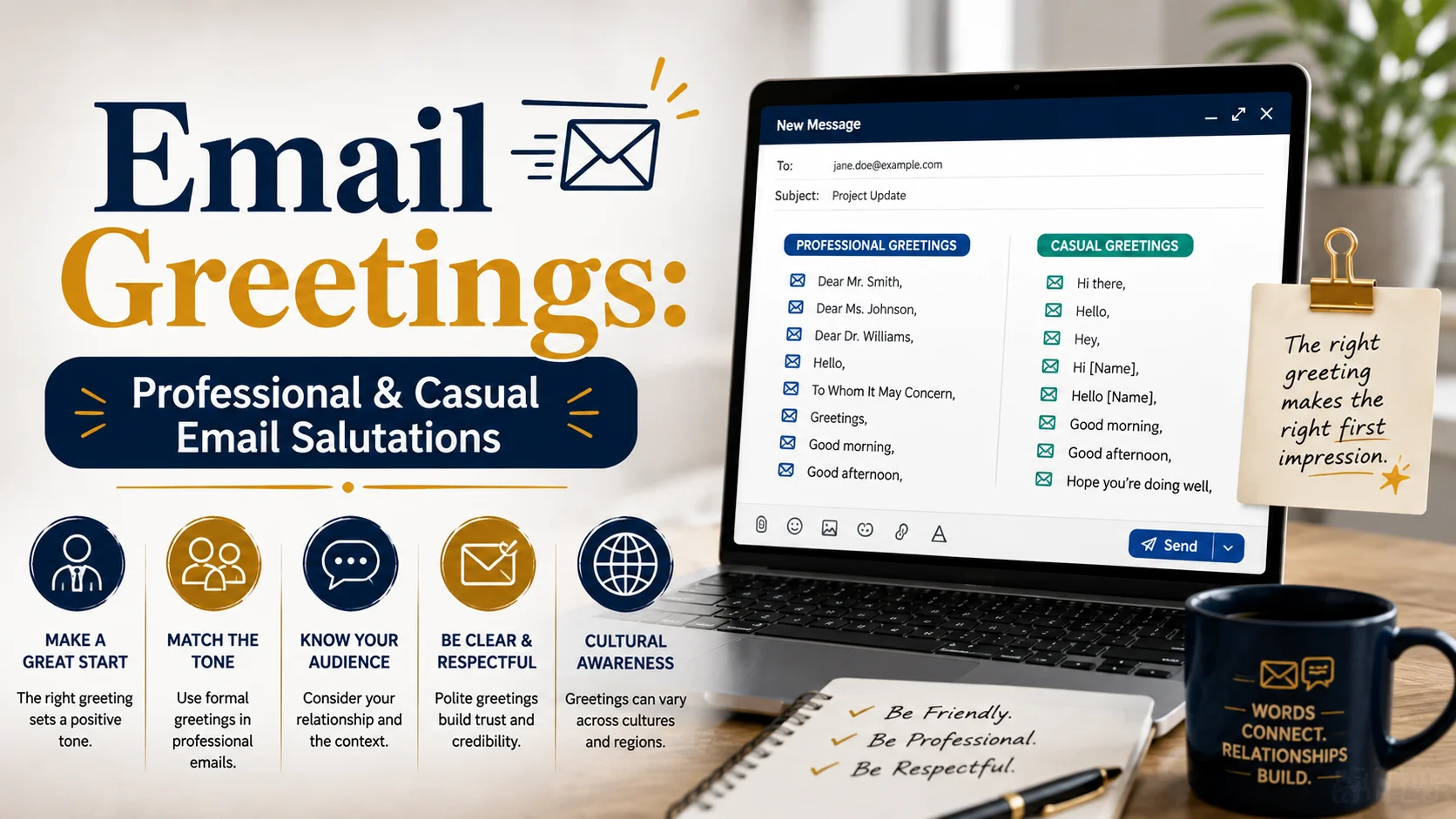
Email greetings are the first words your recipient reads, and they set the tone for your entire message. Whether you are sending a job application, a follow-up with a colleague, or a cold email to a potential client, the right greeting can determine whether your email gets read or ignored. Starting an email without a proper greeting is poor etiquette and can make you seem rude or unprofessional .
This comprehensive guide covers everything you need to know about email greetings. From formal business salutations to casual workplace messages, from subject lines to opening sentences, you will find everything here. Whether you are writing your first professional email or looking to refine your communication skills, this guide has you covered.
Why Are Email Greetings Important?
Email greetings are important because they serve as your digital handshake. They acknowledge the recipient and create a human connection before you dive into the content of your message . A good greeting can be the deciding factor on whether your email gets read .
Email greetings set the tone for the entire conversation. A formal greeting shows respect and professionalism. A friendly greeting shows warmth and approachability. The right greeting encourages the reader to continue reading and helps them perceive you exactly as you would like to position yourself .
Without a proper greeting, your email can come across as rude, dismissive, or overly demanding. It is considered poor etiquette to start an email without acknowledging the recipient .
Formal Email Greetings
Formal email greetings are used in professional settings, when contacting someone for the first time, or when writing to someone in a position of authority. These greetings show respect and professionalism.
Dear [Name]
Dear is the classic formal greeting. You cannot go wrong with this timeless salutation . Use Dear when you want to show respect, especially for job applications, emails to senior contacts, or formal business correspondence.
- Dear Mr. Smith,
- Dear Ms. Johnson,
- Dear Dr. Williams,
- Dear Professor Davis,
- Dear Hiring Manager,
- Dear Sir or Madam,
Good Morning / Afternoon / Evening
Using Good morning, Good afternoon, or Good evening is a polite and respectful way to start an email . It works for both formal and semi-formal emails. However, only use this greeting if you are confident about the recipient’s time zone .
- Good morning, Mr. Patel,
- Good afternoon, Dr. Chen,
- Good evening, Professor Williams,
To Whom It May Concern
To whom it may concern is a versatile and widely used formal greeting for situations where you do not know the recipient’s name . However, it can come across as impersonal, so use it sparingly . It is best reserved for cover letters or formal inquiries.
To Whom It May Concern,
Greetings
Greetings is a safe, conservative, and polite way to start an email when you are unsure of the recipient’s name or gender . It works for both individuals and groups. However, it may come across as cold or distant with people you already know .
Greetings,
Greetings, Mr. Thompson,
Semi-Formal Email Greetings
Semi-formal email greetings strike the right balance between friendly and respectful. They are the go-to for most day-to-day professional emails .
Hello [Name]
Hello is a popular greeting that is slightly more formal than “Hi” but still approachable . It is appropriate for official, unsolicited, and cold-open emails .
- Hello, Sarah,
- Hello, James and Maria,
- Hello, Dr. Lee,
Hi [Name]
Hi is the most widely used professional greeting . It is friendly, direct, and appropriate in almost every professional context except the most formal situations . Using the recipient’s name makes it personal and engaging.
- Hi, Michael,
- Hi, Jessica,
- Hi, John and Lisa,
Good Morning / Afternoon [Name]
Adding the recipient’s name to a time-specific greeting adds a personal touch. It feels warm and thoughtful without being overly formal . Use this when you want to acknowledge the time of day while maintaining a professional tone.
- Good morning, Anna,
- Good afternoon, Tom,
- Good evening, Dr. Patel,
Casual Email Greetings
Casual email greetings are appropriate for internal emails with colleagues you interact with regularly, or when the company culture supports an informal tone . Avoid casual greetings in first-time outreach, job applications, or emails to senior contacts .
Hey [Name]
Hey is friendly and relaxed. It is best for close colleagues and ongoing professional relationships . Use this only when you have an established rapport with the recipient.
Hey, Mark,
Hey, Laura,
Hi There
Hi there is a relatively informal way to address a recipient . Use it when you are familiar with the recipient and communicate frequently . It is also useful when you are unsure of the recipient’s name .
Hi there,
[Name]
Skipping the salutation word and using just the person’s name is acceptable for ongoing email threads and quick internal messages . This works best with colleagues you email regularly.
Sarah,
Michael,
Email Greetings for Groups
When addressing multiple recipients, you need email greetings that acknowledge everyone without being too formal or too casual .
Hello Everyone / Hello Team
Hello team or Hello everyone is a safe, friendly greeting for group emails . It works whether you are sending a message to a small team or a large department.
Hello team,
Hello everyone,
Hi everyone,
Hi [Name 1], [Name 2], and [Name 3]
If you are emailing a small group, you can list the names individually. This feels personal and shows you know who you are writing to .
Hi, Sarah, Mark, and Lisa,
Hello, John and Maria,
Greetings
The Greetings is a safe option for group emails when you are not sure who the recipients are or how to address them collectively .
Greetings everyone,
Greetings all,
Email Opening Lines
The greeting is followed by the opening line. A strong opening line gets the recipient engaged and wanting to read more .
Polite Opening Lines
- I hope this email finds you well.
- I hope you are having a great week.
- I hope you enjoyed your weekend.
- I trust this message reaches you at a good time.
- I hope you are having a pleasant day.
Direct Opening Lines
- I am writing to discuss…
- I wanted to share a quick update on…
- I am reaching out to explore…
- I have a quick question about…
- I am following up on my previous email.
Introducing Yourself
- My name is [Name] and I am…
- I am the new [title] for [department].
- Allow me to introduce myself.
Email Greetings for Different Situations
Different situations call for different email greetings . Here is how to choose the right one.
Cold Emails and First-Time Contact
When emailing someone for the first time, use formal or semi-formal greetings. The goal is to set the right tone and make a good first impression .
- Dear Mr. Smith,
- Hello, Ms. Johnson,
- I hope this email finds you well. I am reaching out because…
- My name is [Name] and I would love to learn more about…
Follow-Up Emails
For follow-up emails, reference previous communication in your opening line. This helps the recipient remember the context .
- I am checking in on my previous email.
- Following up on our conversation about…
- I wanted to circle back to our last discussion.
- As we discussed on our phone call…
- As promised, here is…
Email Replies
When replying to an email, acknowledge the recipient’s message. This shows you have read and appreciate their communication .
- Great to hear from you.
- Thanks for the update.
- I appreciate your quick response.
- Thank you for getting back to me.
- It is great to hear from you.
Job Applications
For job applications, use formal greetings. Dear Hiring Manager is a safe choice when you do not know the contact person .
- Dear Hiring Manager,
- Dear Mr./Ms. [Last Name],
- Dear Dr. [Last Name],
Email Greetings to Avoid
Some email greetings can set the wrong tone or come across as unprofessional. Avoid these .
Too Informal Greetings
- What’s up everyone? is too casual for professional emails.
- Hey team 🙂 emojis should be avoided in professional greetings .
- Yo [Name] is extremely informal and inappropriate for work.
Outdated or Impersonal Greetings
- To whom it may concern is outdated and impersonal .
- Dear Sir or Madam is too formal and impersonal .
- Dear Mr./Mrs. Smith! exclamation marks can seem too enthusiastic and unprofessional .
Subject Lines for Professional Emails
Before your greeting, the recipient sees your subject line. A good subject line is crucial for getting your email opened .
Tips for Writing Subject Lines
- Keep your subject line under 10 words .
- Include the topic of your email .
- Add a brief call to action if a response is needed .
- Be clear and direct rather than vague .
Subject Line Examples
- Q2 Report Ready for Review – Action Needed
- Meeting Request: Monday, June 17 at 3 PM
- Requesting approval for Project X – Response needed by Friday
- Weekly Memo – Reply Requested EOD
Common Mistakes to Avoid with Email Greetings
- Many people make mistakes with email greetings. Here are some to avoid.
- Misspelling the recipient’s name is a common mistake. It is considered careless and disrespectful. Always double-check the spelling .
- Using the wrong formality level can also be problematic. Do not be too casual with someone you do not know well. Do not be too formal with people you email daily.
- Forgetting a greeting altogether is poor etiquette. Never jump straight into the body of the email without acknowledging the recipient .
- Using exclamation marks, emojis, or abbreviations in professional greetings should be avoided. These can make you seem unprofessional or overly casual .
How to Choose the Right Email Greeting
- Choosing the right email greeting depends on several factors.
- Consider your relationship with the recipient. Formal for strangers and superiors. Casual for colleagues and friends.
- Consider the context. Formal for job applications. Semi-formal for most professional emails. Casual for quick internal updates.
- Consider the company culture. Some workplaces are formal. Others are casual. Adapt to the culture of your workplace .
- Consider whether you know the recipient’s name. Use their name whenever possible. Use general greetings when you do not.
Frequently Asked Questions About Email Greetings
What is the best professional email greeting?
Hi [Name] is the most widely used professional greeting . It works in almost every professional context except the most formal situations. Hello [Name] is slightly more formal and also a great choice .
Is Dear outdated for emails?
Dear is not outdated for formal emails. It is still the preferred greeting for job applications, formal correspondence, and emails to senior contacts . However, for day-to-day professional emails, Hi or Hello is more common .
Can I use Hey in a professional email?
Use Hey only with colleagues you know well in informal contexts . For professional emails to people you do not know well, stick to Hi or Hello.
What greeting should I use if I do not know the recipient’s name?
Use Greetings, Hello, Hi there, or To whom it may concern . If you are emailing a department, you can use Dear Hiring Manager or Dear [Department] Team .
Should I always use the recipient’s name?
Yes, whenever possible. Using the recipient’s name makes the greeting more personal and engaging . If you are unsure of the spelling, double-check before sending .
What is the difference between a colon and a comma after a greeting?
A colon (Dear Mr. Smith:) is very formal and works well for cover letters. A comma (Dear Mr. Smith,) is standard for most business emails .
How do I start an email to multiple people?
Use Hello everyone, Hi team, Greetings, or list individual names if the group is small .
Conclusion
Email greetings are the first step in effective professional communication. From formal Dear to friendly Hi, from time-specific Good morning to group-friendly Hello everyone, choosing the right greeting sets the tone for your entire message. Remember to consider your relationship with the recipient, the context, and the company culture.
Start with a strong subject line. Choose the appropriate greeting. Follow with a clear opening line. And always double-check the spelling of your recipient’s name. Your words have power. A well-crafted email greeting can open doors, build relationships, and ensure your message gets the attention it deserves.